If you have been through a Pilates class, there is something that instructors often mention. The phrase is: “engage your core.” The message appears quite clear.
However, when we consider pelvic floor Pilates, it turns out to be rather misleading than clear. Almost everyone tends to understand it in the same manner: engage all muscles and hold. So they do – through the whole class, sometimes without even noticing.
At first, it feels like you’re doing it “right.” Focused. Controlled.
But then something shifts. The movement feels heavier. Breathing gets shallow. And instead of feeling stronger, you feel… tense.
If you’ve ever caught yourself wondering, “Do you need to engage your pelvic floor in Pilates all the time?” – that’s usually a sign your body is trying to tell you something.
At BK Pilates studios – whether in Flatiron, NoMad, Park Slope, Chelsea, or South Brooklyn – we see this pattern all the time. It’s rarely about not doing enough.
More often, it’s about doing too much.
Because in reality, pelvic floor in Pilates is not about constant engagement. It’s about knowing when to engage – and just as importantly, when to let go.
What Is the Pelvic Floor (and How It Works in Pilates)
Pelvic floor muscles do not act independently; it is precisely what makes them exciting.
All of these elements belong to a bigger picture involving your inner abdominal muscles, your diaphragm, and even your back muscles. Everything reacts.
Inhaling triggers relaxation of the pelvic floor. Exhaling triggers contraction of the pelvic floor. Nothing drastic. Nothing forced. Just a subtle movement.
This movement tends to get ignored, particularly if you’re accustomed to “stabilizing” your core. Once you become aware of this pattern, however, everything starts to shift.
Movements feel smoother. Less forced. And more coordinated.
It’s not about adding effort. It’s about allowing the body to work the way it’s designed to.
📌 Read more: if you want to understand this deeper, explore how breath and control come together in our guide to mindful movement on the BK Pilates blog.
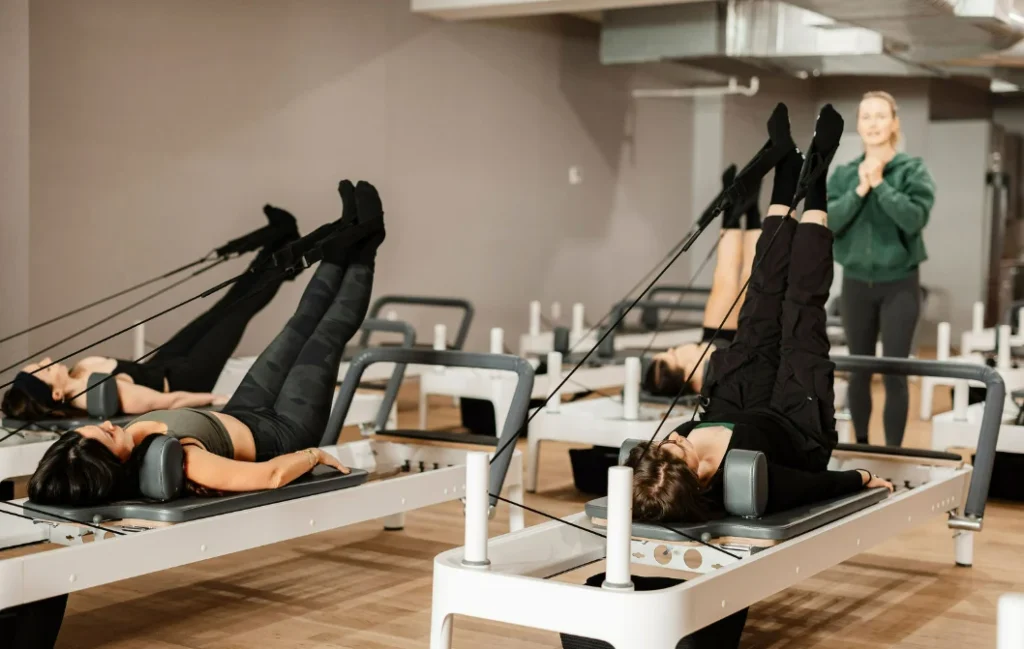
Should You Always Engage Your Pelvic Floor in Pilates?
This is where expectations and reality tend to clash.
The idea of constant engagement feels safe. Logical, even.
If muscles support you, then more activation should mean more support… right?
Not exactly.
In pelvic floor Pilates, holding tension all the time can actually do the opposite of what you want. Instead of creating stability, it can limit how your body moves and breathes.
Think of it this way: a muscle that never relaxes can’t fully contract either. It loses its range.
“A lot of clients come in thinking they need to keep everything ‘on’ the entire time,” says a BK Pilates instructor.
“But once they learn to release, their movement improves almost immediately.”
So if you’re asking, should you engage the pelvic floor constantly?
A better answer might be: only when it supports what you’re doing – not by default.
When Engagement Helps (And When It Doesn’t)
There are moments when engaging the pelvic floor makes a real difference.
Usually, it shows up during slower, more controlled movements – when your body needs a bit of extra support.
In those moments, the engagement feels almost subtle. Not something you force, but something that happens with the movement.
But here’s the part people don’t always expect: the line between “helpful” and “too much” is thin.
Once engagement shifts to gripping, everything else changes: breathing gets limited, movement gets reduced, and other muscles begin compensating for the problem.
Here is an easy model to understand:
| Balanced Engagement | Too Much Engagement |
| Feels light and responsive | Feels tight or held |
| Follows your breath | Interrupts your breath |
| Supports movement | Limits movement |
| Leaves you energized | Leaves you fatigued |
In pelvic floor exercises Pilates, this difference matters more than intensity.
Signs Your Pelvic Floor Might Be Too Tight
We talk a lot about strengthening the pelvic floor – but not as much about when it’s already doing too much.
An overactive pelvic floor doesn’t always announce itself clearly. It’s often subtle.
Maybe you notice that relaxing feels unfamiliar.
Or that your breath never quite drops fully into your body.
Or that there’s a low-level tension you can’t really switch off.
The symptoms of pelvic floor tightness might not sound too alarming, but they definitely affect how your body moves.
According to the American College of Obstetricians and Gynecologists, pelvic floor dysfunction is defined as a problem involving muscle weakness and/or muscle tension. And the two conditions require a completely different approach.
So simply working harder doesn’t have to be the solution.
How to Relax Your Pelvic Floor
This may be just what you have been missing.
When searching for “how to relax the pelvic floor” or “how to relax a tight pelvic floor”, chances are you have found recommendations to include more activities. But real change doesn’t usually start there.
In pelvic floor Pilates, relaxation begins with awareness. It’s about noticing when your body is holding tension – often without you even realizing it.
Breath plays a key role here. The process of breathing slowly allows the natural relaxation of the pelvis, which occurs by itself, rather than through forced efforts.
Here, the goal would be to do as little as possible, in contrast to the previous examples that involved doing as much as possible. At first, this can feel unfamiliar. Sometimes even a bit uncomfortable – simply because it’s new.
That’s normal.
Learning how to relax pelvic floor muscles is a process. Not something you switch on overnight, but something you build gradually – especially with guidance.
Pilates vs Kegels: What Most People Get Wrong
Kegels have become almost synonymous with pelvic floor work.
But they tell only part of the story.
Kegels focus on contraction. Pilates focuses on coordination.
That difference matters more than it seems.
In pelvic floor Pilates, the goal isn’t just to strengthen – it’s to integrate. In order to coordinate the action of the pelvic floor with breathing, core, and movement.
When someone already has a very tight pelvic floor, further contraction without training to release may cause additional tension.
That is why so many specialists, including NIH, recommend movement-based techniques rather than exercises only.
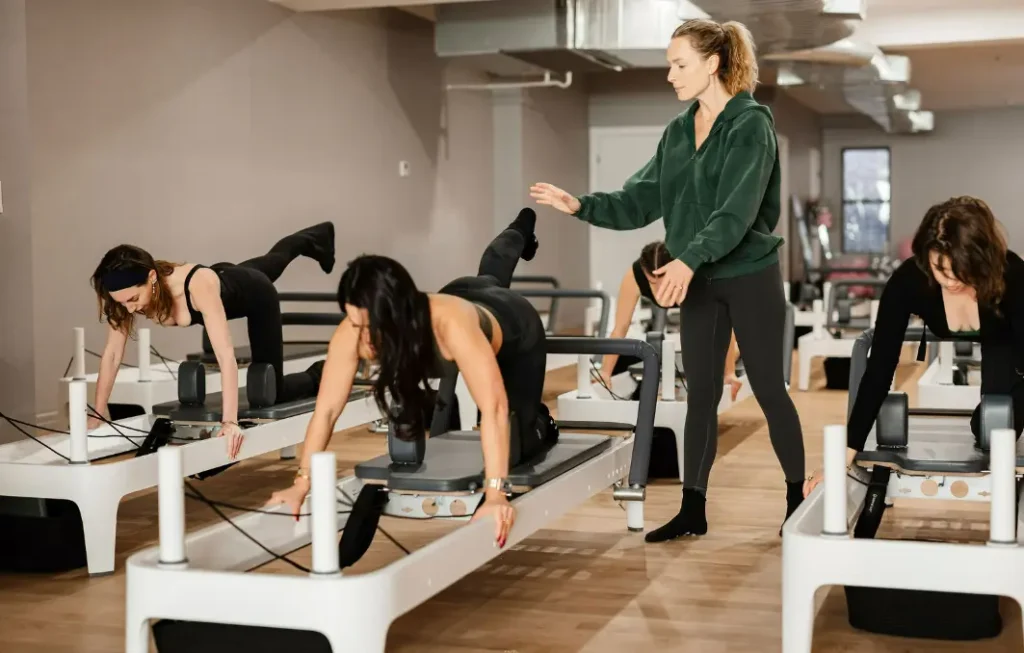
What About Pelvic Floor After Childbirth?
After pregnancy, the pelvic floor changes – but not always in the same way for everyone.
Some people experience weakness. Others feel more tightness than before.
Both are equally true and equally important.
If you find yourself on your pelvic floor journey after birth, it isn’t about working harder but rather reestablishing awareness.
📌 Read more: you’ll find a full breakdown in our postpartum recovery guide on the BK Pilates blog.
How Pilates Actually Trains Your Pelvic Floor (Without Overthinking It)
One of the things people often notice in Pilates is that it doesn’t feel forced.
You’re not isolating muscles or trying to control every detail. Instead, your body starts to find a rhythm.
Breath leads. Movement follows. And somewhere in between, the pelvic floor does exactly what it needs to do – without constant effort.
“Clients are often surprised that things start to feel easier, not harder,” says a BK Pilates instructor.
“This is when you can tell that the body works together rather than against itself.”
Ultimately, this will develop an ability that cannot be faked: strength combined with grace.
The Takeaway: This Is Not About Tension – It’s About Mastery
Do you need to activate your pelvic floor in Pilates exercises? Yes – but not always, and not for the reasons that you would imagine.
Pelvic floor Pilates involves more mastery of the body than exerting tension. When to engage. When to relax. How to connect both with your breath.
Once that balance starts to click, everything changes – not just how you move, but how you feel in your body.
At BK Pilates, that’s exactly what we focus on in every session, across all our studios in Flatiron, NoMad, Park Slope, Chelsea, and South Brooklyn.
FAQ
Do I need to keep my pelvic floor engaged the whole time in Pilates?
Honestly, no. We actually see this a lot – people trying to hold everything tight from start to finish. But your pelvic floor isn’t meant to stay “on” all the time. It should respond to the movement and your breath. When you let that happen, everything starts to feel much more natural.
Can Pilates really help me relax my pelvic floor?
Yes – and for many people, that’s the part they didn’t even realize they needed. In class, we don’t just focus on engagement. We also guide you into releasing that tension, especially through breath. And once that clicks, the whole body feels different.
Is it bad if I’m constantly tightening my pelvic floor?
It can be, yeah. It might feel like you’re being “extra engaged,” but over time it usually creates more tension than support. We usually find that once they have stopped overworking themselves, their coordination actually gets better rather quickly.
What will let me know that my pelvic floor muscles are too tight?
Initially, many individuals may be unaware. Nevertheless, if it appears difficult for one to unwind or if one finds themselves getting tense unintentionally, then this may be an indication. Sometimes it also shows up as shallow breathing or that feeling of always being slightly “on.”
So… Kegels or Pilates – what’s better?
It all depends on the individual, but in most cases, Pilates gives you a better overall perspective. When it comes to kegels, the emphasis is placed on contraction, but with Pilates, you’ll be able to know when to contract and when to release.
CTA
If your exercises make you feel tense rather than powerful, then it’s high time to try exercising differently. At BK Pilates, we help you find that balance – so your body feels supported, not restricted.