Quick Answer: Can Pilates Replace the Gym?
It completely depends on what you’re pursuing, but for the vast majority of us, the answer is a resounding yes. You are pursuing: excellent core stability, impeccable posture, excellent mobility, and lean, dense muscle tone. You don’t need to pack yourself into a gym. On the flip side, if you are actively trying to build massive bodybuilder bulk, maximize your deadlift PR, or train for explosive sprint power, Pilates won’t replace those heavy iron sessions. Instead, it becomes the ultimate recovery and alignment tool to keep you from getting injured.
Living in a relentless city like New York means our fitness choices usually mirror our schedules – rushed, high-stress, and completely draining. For a long time, commercial gyms had the exclusive hold on the idea of getting fit. However, for a second here, and in all seriousness: if right now you are looking at your running shoes, filled with a sort of heavy feeling of despair and doom, please know, you’re not the only one. Countless working professionals and suburban gym rats struggle with: can Pilates replace the gym , or am I risking my own health by stepping away from traditional workouts?
This is not a one size fits all question. Your individual physical goals will determine what the parameters are. Creating an enduring movement practice habit, recovering from full gym burnout, or searching for a truly sustainable alternative to the gym for women-whatever your goals are, first you need to understand precisely what it is that Pilates does to your body.
What People Really Mean When They Ask “Can Pilates Replace the Gym?”
When new clients open the door to our studios, this question is rarely driven by casual curiosity. It almost always comes from a place of sheer physical and mental exhaustion.Traditional fitness marketing has spent decades convincing us that the only type of workout is one that you’re completely wiped out, perpetually in inflammation or currently managing your rage-filled lower back or knee.
When people ask whether they can be freed from their everyday gym membership for a reformer class, they are essentially saying “I am over it.” They are over the highly aggressive energy of the weight room, the soul-crushing, mental emptiness of treadmill lines and the relentless cycle of workout exhaustion. They are not asking how they can be the next bodybuilding champion; rather, they want effective functional daily strength, sharp posture, heightened energy and a body that functions gracefully without requiring them to spend two hours per day inside a dank gym basement. Pilates feels like the opposite of punitive physical conditioning in the best possible way: it makes use of extreme movement accuracy in a way that is the antithesis of damage, and your mind and body are talking.
When Pilates Can Replace the Gym
For General Fitness and Strength
If fit means easily managing daily tasks, hauling a sack of groceries without a strained back, or feeling toned and tight throughout your body-Pilates is definitely sufficient for you. While the gym sometimes isolates individual muscle groups- Pilates is a system approach. Each movement is initiated by your power house (deep abs, glutes, and lower back). So that your strength becomes actual, everyday functionality.
Improves Posture and Flexibility
Years spent in an office chair or glued to an iPhone give most city professionals tight hip flexors, round shoulders, and aching necks. Instead of contributing to these habits by making an already contracted muscle shorter, Pilates encourages eccentric muscular contractions-making a muscle longer and stronger.
It is the gold standard for spinal alignment and joint mobility.
For Low-Impact Workouts
Your joints have a shelf life when subjected to continuous high-impact pounding. Regardless of whether you’re in recovery or just want a strong core to avoid a knee or lower back injury, Pilates will provide you a real workout in the most structurally-low environment imaginable. Instead of dealing with gravity and heavy iron, Pilates uses springs and pulleys to provide a safe and incredibly effective full body workout.
For the Busy Professional Trying to Be Balanced
The truth is… a workout that doesn’t work out does not work out. Juggling a career and a busy social life typically lists a ninety minute gym visit as number one on the cut-off list. The programs under the Pilates modality are highly efficient, are very specific, can leave you energized and not depleted, making it miles easier to stick with week after week, year after year.
When Pilates Is Probably Not Enough on Its Own
If true clinical skill is to be maintained, then we must recognize the inherent limitations to training with any single movement modality:
- Extreme Hypertrophy goals: If extreme muscle bulk or building a significant body builder physique is the goal, the progressive overload derived from working with heavy external weights cannot be replicated with this single method.
- Athletic performance and Explosive strength: Sports requiring immediate bursts of maximum power such as sprinting, Olympic lifting or elite-level competitive sports necessitate workout regimens that concentrate on the activation of fast twitch fibers.
- Progressive lifting skills: if extreme focus and progression are placed upon mastering technical lifts such as the snatch or clean and jerk, Pilates is likely a tool of active recovery.
Can Reformer Pilates Build Muscle?
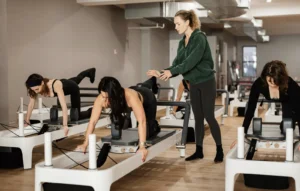
Most frequently this exercise method is mistaken as an all-encompassing gentle stretching workout. I am sure that those who have ever attempted a plank on a carriage that is sliding underneath them understand that this isn’t so simple. But does reformer pilates help build muscle?
| Feature | Pilates | Traditional Gym |
| Posture Alignment | Excellent | Moderate |
| Muscle Hypertrophy | Limited (Lean Tone) | Excellent (Bulk) |
| Flexibility | Excellent | Moderate |
| Joint-Friendly | Excellent | Varies / Low-Impact |
| Stress Reduction | High (Mindful) | Moderate |
The Difference Between Functional Strength and Muscle Size
So yes, you build muscle on a reformer, but you build lean muscle. When you’re in the gym you mostly do concentric movements that shorten the muscle to add bulk. On the reformer you use the springs for the eccentric portion to develop long, lean muscle. You gain structural strength, and get that tight waist without gaining bulk.
Why Reformer Pilates Feels Hard Even Without Heavy Weights
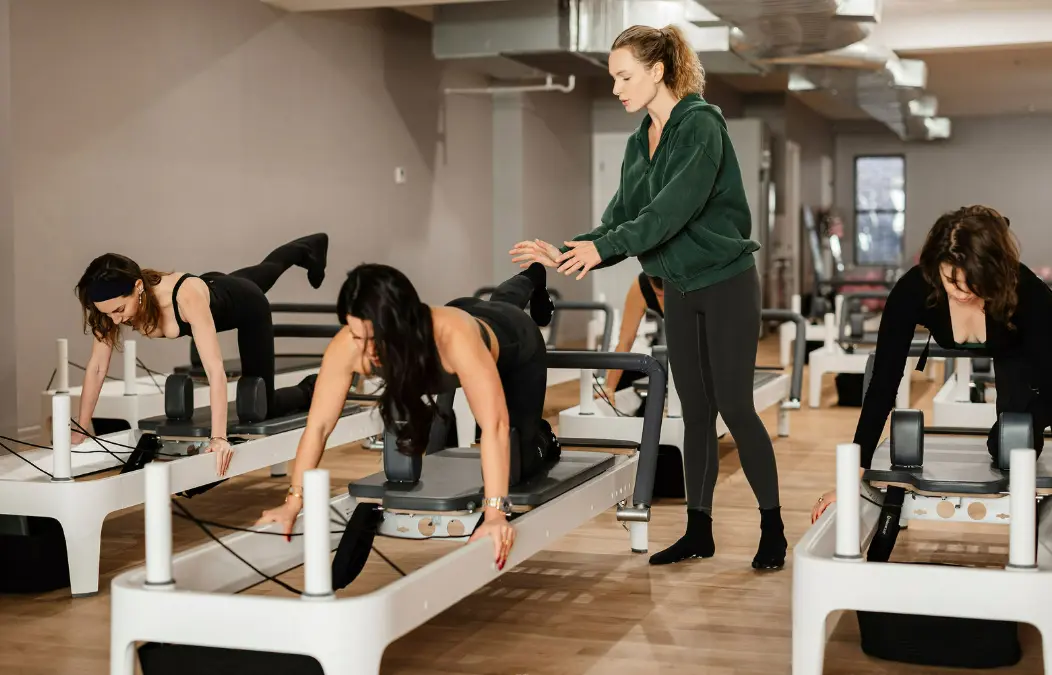
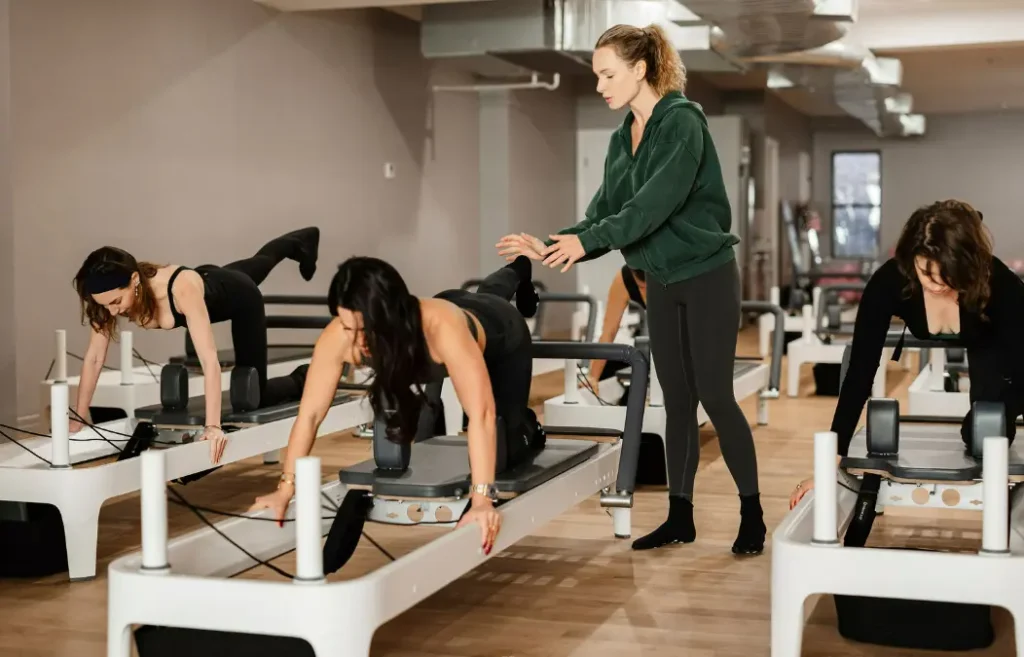
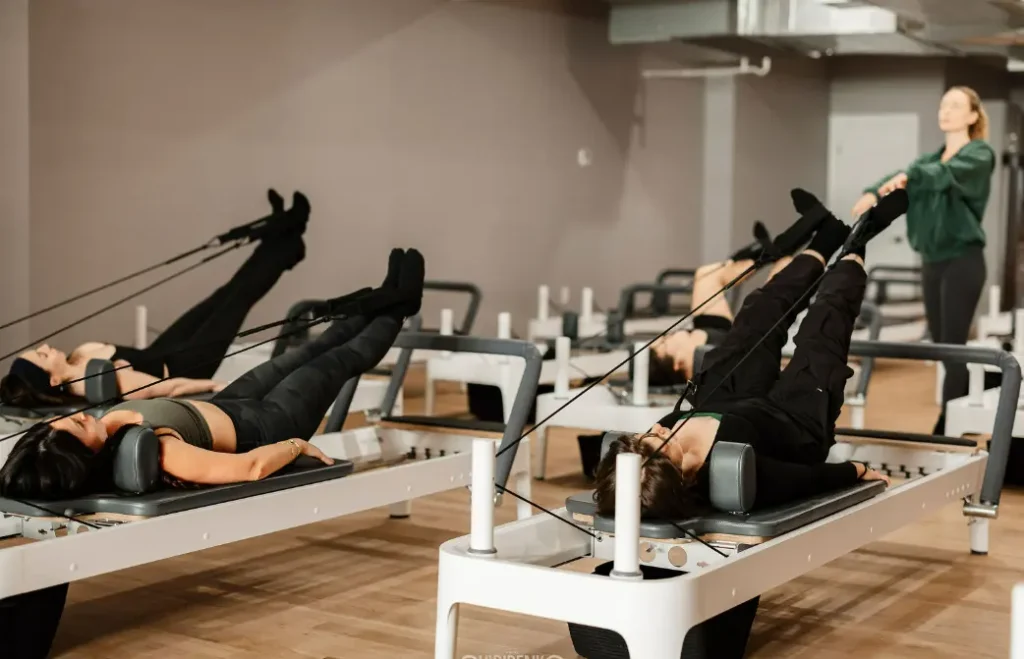
It’s down to the dynamic instability of the reformer carriage and different spring tension levels. You are not working against a stationary machine as you would be in a gym; you are using your core stabilization muscles to keep the carriage under control. Unstable surface training leads to significantly more activation in the core musculature and more neuromuscular control. It forces your stabilising systems to work at their limits, that’s why a fairly basic movement can have you shaking in minutes.
Can pilates replace weight training?
When comparing pilates vs gym, the best routine is always the one you actually look forward to doing. Consistency is the ultimate variable in fitness success.
Recovery and Soreness
You need a long period of recovery after a hardcore gym session because of the amount of micro-tearing your body is enduring, and also because of the fatigue in the nervous system. Pilates, on the other hand, relies on controlled, non-impact moves, allowing good blood circulation and improving flexibility, which makes it an ideal recovery-tool that can be performed on many days of the week without your muscles hurting like crazy, or you having the nervous system completely spent.
Time and Lifestyle
Gym workouts are a lot of work because they demand planning: shuffling weights, taking turns at machines, charting splits. Pilates sessions, however, are directed, intentional, and have a trained teacher to make sure you’re getting the most out of each and every minute without expending mental energy.
Motivation & Burnout
A gym’s high-pressure environment and sterility is prone to psychological burnout. A studio, however, creates a mindful atmosphere that lowers cortisol and the nervous system, while simultaneously giving you an intense physical workout.
“I used to force myself to go to a traditional gym in Flatiron three days a week, and I hated every minute of it. I felt stiff from my corporate job, and heavy squats only made my lower back hurt worse. Switching to reformer pilates nyc sessions completely changed my relationship with fitness. I’m leaner and stronger than I ever was from lifting weights, and I actually leave the studio feeling completely energized instead of broken down.”
– Sarah M., BK Pilates Client
Why Many Women Transition From the Gym to Pilates
There’s an enormous paradigm shift happening out of extreme, high stress fitness and moving toward longevity and intense somatic awareness. Women are shifting out of traditional weights, not because they aren’t willing to work hard. But because the system is not structurally sustainable. Women are selecting the system that will be good to their joints, supportive of the pelvic floor, low-stress overall, and create an innate bodily confidence. We are no longer striving for an unachievable, photoshopped “Pilates body,” but a strong, fluid, body comfortable.
“At our boutique BK Pilates NYC spaces, we regularly welcome people who are completely burned out by high-intensity gym cultures. They come to us looking for an intelligent gym alternative for women that delivers real physical results while protecting their peace of mind.”
– Instructor BK Pilates
Can You Combine Pilates and Gym Workouts?
And who says you can’t do both? A hybrid seems like the most sensible way for many of us to build strength, while keeping your cardiovascular health, and skeletal structure intact long term.
The Best Weekly Breakdown
For those interested in building a bridge between both of worlds, the following seems to be quite an effective structure to build upon each week:
2 Days: Strength Training (compound gym movements like the deadlift, overhead press)
2 Days: Reformer Pilates classes (to maintain spinal alignment, keep joints stable, and build core stability)
1 day: dedicated low intensity cardio, or active recovery
Pilates before, or after strength training?
If you wish to complete both on the same day, it would be wiser to perform Pilates after the heavy lifting is done, or even the following day. You do not want to pre-fatigue your core deep stabilizers prior to placing a heavy barbell across your shoulders in the gym as these muscles keep your spine healthy.
Read more Pilates vs the Gym: Which Is Better for Long-Term Body Changes?
How to Start Pilates If You’re Used to the Gym
Transitioning from traditional weightlifting to a reformer can be a humbling experience. Gym-goers are often shocked by how challenging a beginner pilates nyc class can feel.
- Leave Your Ego at the Door: You might be able to leg press hundreds of pounds. But controlling a light spring on a moving carriage uses entirely different muscle groups.
- Focus on the Slow Down: The gym often rewards speed and explosive momentum. Pilates rewards slow, deliberate, eccentric control.
- Listen to Your Breath: Pilates utilizes specific lateral breathing patterns to deeply engage your stabilizing powerhouse. Pay close attention to your instructor’s breath cues.
FAQ
Is Pilates enough exercise on its own?
Yes. The level of weekly activity as described will fulfill all of the conditions for good health, function, flexibility and cardio with Pilates alone.
Is Pilates like weight training?
Yes. Pilates can substitute weight training if one wants lean muscle tone, muscular endurance, and a strong center. It can not provide the same level of absolute power and maximal muscle bulk from progressive, heavy barbell training.
Is Pilates a good exercise for strength?
Yes! The deep, stabilizing, and intrinsic muscular system. Completely ignored by all gym machines, is intensely and specifically trained with Pilates, developing tremendous muscular endurance and great core and back strength.
Why do people leave the gym for Pilates?
Because chronic exhaustion from the gym is a killer, to avoid chronic strain or bore you might develop training the same way. To experience low impact peaceful movement that does not lead to yet more exhaustion while you are so busy.
Final Thoughts: The Best Workout Is the One You Can Sustain
Ultimately, asking – is pilates enough exercise depends on your personal definition of health. If your goals are rooted in functional strength, impeccable posture, reduced pain, and a long-term commitment to movement, then Pilates isn’t just enough – it is extraordinary.
If you are ready to experience a workout that builds your body up instead of wearing it down, step away from the crowded gym floor. Discover our welcoming urban communities and view our current schedule. BK Pilates Classes NYC to book your first reformer carriage today.