If your first reformer class left you confused, sore in unexpected places, or wondering why Pilates is so hard when it looks effortless on Instagram – you’re not alone. The reformer punishes certain habits that other workouts let you get away with. The machine has opinions, and it expresses them through a wobbling carriage, shooting springs, and muscles that fire in ways you didn’t plan.
The table below covers what goes wrong – and why. Full breakdown of each mistake follows.
| Mistake | What happens on the reformer | Quick fix |
| Wrong clothing & no grip socks | Sliding footbar, instructor can’t see alignment | Grip socks + fitted clothing |
| Moving too fast | Carriage slams into the stopper, momentum replaces muscle | Return phase = same time as the drive |
| Holding your breath | Neck and shoulder tension, core compensation | Lateral breathing – ribs expand sideways |
| Tensing the shoulders | Closed torso, blocked breathing, wrong muscle recruitment | Shoulders down before every exercise |
| Confusing strength with stability | Pelvis shifts when the carriage moves | Neutral pelvis throughout every movement |
| Over-tucking the pelvis | Spine loses natural curve, load shifts to wrong structures | Lift, not tuck |
| Not telling the instructor about your body | Rib pain, unnecessary compensation patterns | Talk to your instructor before class starts |
Wearing the Wrong Clothes (and Showing Up Without Grip Socks)
The reformer footbar and carriage surface are slippery. Bare feet work on a yoga mat. On the reformer, they’ll slide at the exact moment you’re trying to stabilize. Grip socks aren’t a studio upsell – they’re functional equipment.
Clothing matters for a different reason: your instructor needs to see your alignment. Loose shorts make it impossible to tell whether your knee is tracking correctly, your hip is rotating, or your pelvis is neutral.
What to bring to your first Pilates class:
- Grip socks with rubber grip points – most studios sell them, but bring your own
- Fitted leggings or shorts, no zippers, pockets, or hardware that can catch on the carriage
- A top that won’t ride up during strap work or inversion-adjacent positions
- Water – the sessions are drier than they look
That’s the entire checklist for how to prepare for first Pilates class – and how to prepare for Pilates in general. Everything else is learned in the room.
Moving Too Fast
The reformer corrects this one faster than any other – and more visibly. When you rush through footwork or a long stretch, the carriage ricochets – it slams into the stopper at the end of the rails instead of gliding back under control. That ricochet tells you exactly what happened: momentum did the work, not your muscles.
Pilates was originally called Contrology for a reason. The slow return phase of every movement is where most of the actual training happens. Speed eliminates that phase entirely.
Why is Pilates so hard when you slow down? Because suddenly the stabilizer muscles have to work the whole time instead of coasting. That’s the point.
Fix: On any pushing exercise, make the return take at least as long as the drive. If the carriage is making noise, you’re moving too fast.
Holding Your Breath
In most gym environments, holding your breath through the hard part is instinctive – it’s how you brace for a heavy lift. On the reformer, it’s counterproductive. Pilates breathing is lateral: the ribcage expands outward on the inhale, not the chest upward. The abdominals stay engaged throughout.
Why does Pilates hurt so much when the breath is wrong? Because held breath creates tension in the neck and shoulders, which then compensates for the core work that should be happening. The pain is usually the wrong muscles doing too much.
Fix: Place your hands on the sides of your ribcage before class starts. Breathe so your hands move apart on the inhale. If your shoulders rise, the breath pattern is wrong. This is the single most useful thing you can practice when learning how to do Pilates – before you ever get on the machine.
Tensing the Shoulders
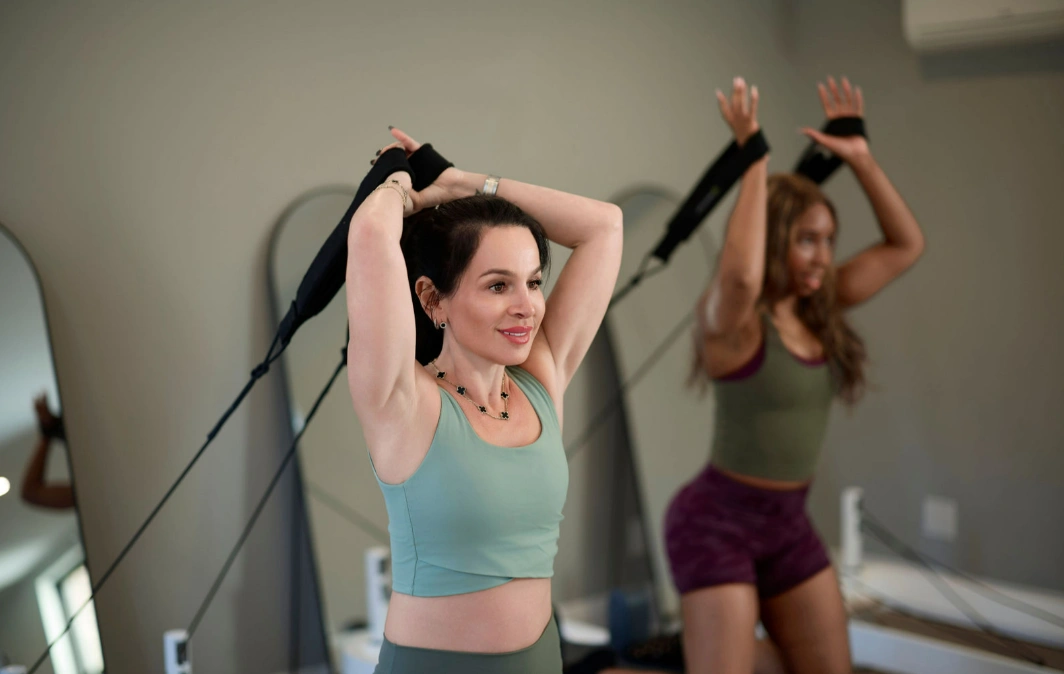
The reformer uses your arms constantly – straps, footbar, handles. Every time load goes into your hands, there’s a pull toward hunching: shoulders rise, upper back rounds, neck shortens. This is one of the most reliable signs of a first-time reformer client, and it usually means the load is too heavy or the movement pattern is unfamiliar.
Shoulder tension also blocks the lateral breathing from the previous section. The two habits compound each other.
Fix: Before each exercise, roll your shoulders up, back, and down. Think of your shoulder blades sliding into your back pockets. In pulling exercises, initiate the movement from the mid-back, not the arms. If you can’t keep the shoulders down, reduce the spring resistance – that’s a legitimate Pilates tip, not cheating.
These Pilates tips – slow the carriage, breathe laterally, shoulders down, neutral pelvis – compound over time.
Confusing Core Strength with Core Stability
People who already train get caught by this one most often. You can have strong abs and still be unstable on the reformer – because the machine tests stability, not just strength. Every time the carriage moves, your pelvis and spine have to hold position against a load that’s trying to shift them.
Doing crunches builds rectus abdominis strength. It doesn’t build the deep stabilizer activation that keeps your spine neutral when a carriage is moving beneath you. That’s a large part of why is Pilates difficult even for people who are otherwise fit – it demands a type of muscle control most training never develops.
This is also why “why am I not sore after Pilates” is one of the most common questions after the first few classes. The stabilizer muscles don’t produce the same delayed onset soreness as muscles worked through large range of motion. The training is happening even when you can’t feel it the next day. By week three, that changes.
How to find and hold a neutral pelvis on the reformer:
- Lie on the carriage with feet on the footbar
- Find the midpoint between maximum forward tilt and maximum backward tilt of the pelvis
- Place your fingertips 2–3 inches below your navel
- Engage your core – your fingers should feel resistance without the pelvis moving
- Hold that position as the carriage begins to move – this is neutral, and this is the goal
Over-Tucking the Pelvis
Instructors cue “scoop the abdominals” and “tuck the tailbone” constantly, and beginners often take this too far – they tuck so aggressively that the spine loses its natural curve and the lower back flattens against the carriage. This looks like correct form and isn’t.
A neutral pelvis isn’t perfectly flat – it has a gentle natural curve. Over-tucking eliminates that curve, shortens the spine, and shifts load onto structures that aren’t designed to carry it. It’s one of the less-discussed cons of Pilates instruction: the cues are shorthand, and shorthand gets misapplied.
Fix: The cue is lift, not tuck. Engage the core upward and inward rather than pushing the pelvis under. If you’re not sure whether you’re over-tucking, ask your instructor for a form check before the session starts – that conversation takes 30 seconds and changes the quality of the entire class.
Not Telling the Instructor About Your Body
This is the mistake that creates the most unnecessary difficulty – and occasionally the most unnecessary pain. Why do my ribs hurt after Pilates? Usually because a movement wasn’t modified for a pre-existing condition, body proportion, or mobility limitation the instructor didn’t know about.
The reformer is exceptional at working around injury – but only if the instructor knows what to work around. These are all things worth mentioning before your first Pilates class:
- Previous or current lower back issues
- Shoulder impingement or rotator cuff history
- Hip flexor tightness or hip replacement
- Knee problems, especially anything affecting tracking
- Wrist or elbow issues that affect weight-bearing
Every one of these has a reformer-friendly alternative that delivers the same training stimulus without the compensation. What makes this one of the real Pilates disadvantages for beginners is that most people don’t know to mention these things – they assume the class format is fixed. It isn’t.
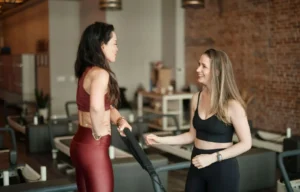
Fix: Arrive 5 minutes early and have a 2-minute conversation before the session starts. Not during the warmup – before.
Is Pilates Hard? What to Expect in the First Month
Yes – doing Pilates correctly is genuinely difficult, and hard in a way most fitness backgrounds don’t prepare you for. The difficulty is neurological: you’re learning to recruit muscles with precision, in unfamiliar sequences, while managing a moving piece of equipment.
In the first month, expect:
- Disorientation from the machine’s feedback – the carriage tells you things your body hasn’t heard before
- Neck and shoulder soreness from compensation patterns you didn’t know you had
- The feeling that nothing is working, followed by sudden clarity in week three or four
- Instructor cues that don’t land until the fifth or sixth time you hear them
The Pilates disadvantages in those first weeks are real: it’s disorienting, the feedback is relentless, and progress is subtle enough that it’s easy to miss. Push through the first four sessions and the method becomes genuinely hard to give up – not because it gets easier, but because the difficulty starts to make sense.
If you want to start with instruction that meets you where you actually are – Book a class and we’ll take it from there.
FAQ
Is Pilates hard for beginners? Yes, specifically because it requires neuromuscular precision that most training backgrounds don’t develop. The difficulty shifts from “confusing” to “genuinely challenging” around weeks three to four.
How to prepare for a first Pilates class? Grip socks, fitted clothing, arrive 5 minutes early to tell your instructor about any injuries or limitations.
Why is Pilates so hard even when you’re already fit? Fitness from other modalities doesn’t transfer directly to stabilizer activation and movement precision. Strong abs don’t guarantee core stability on a moving carriage.
Why does Pilates hurt so much in the first sessions? Usually because the wrong muscles are compensating – neck and shoulders from held breath, lower back from pelvis instability. As technique improves, that pain disappears.
What are the cons of Pilates? The learning curve is steep in the first month, results require consistent attendance, and without qualified instruction the technique errors compound rather than self-correct.