That burn on the side of your torso during a twist or crunch – most people assume it means the obliques are working. Sometimes it does. But oblique training done without intentionality leaves most of the muscle’s actual function untouched, which is why the core still feels weak under load even after months of ab work.
This is what the obliques muscle group actually does, where it sits in the body, and what correct training looks like.
What Are Obliques? Anatomy Without the Textbook
The obliques are a paired group of muscles running along the sides of your abdomen. The side abs name sticks because that’s where you feel them – but it undersells what they actually do by about four functions.
There are two layers:
External obliques – the outermost layer, running diagonally downward from the lower ribs toward the pelvis. These are the muscles visible in a developed, lean midsection: the ones that create the diagonal lines flanking the rectus abdominis. External obliques are the largest of the abdominal muscles by surface area.
Internal obliques – sitting directly beneath the external layer, running in the opposite diagonal direction. They’re not visible, but they’re doing most of the stabilization work during compound movements.
Together they form a crossed-fiber system – an X-shaped arrangement across your torso – that allows rotation in both directions while simultaneously resisting unwanted movement.
Where Are Obliques Located in the Body
Where are the obliques located exactly? Along the lateral walls of the abdomen – but they extend further than most people expect. The oblique muscles run along the lateral walls of the abdomen, from the lower ribs down to the pelvis and hip bones (iliac crest). If you’ve ever asked “where are my obliques” – place your hands on your sides, thumbs toward your spine, fingers toward your navel. Your palms are sitting right over them. The internal obliques lie underneath, slightly more forward.
Many people are surprised to find that obliques extend further around the torso than expected. They’re not just “the sides” – they wrap partially around the back and connect into the thoracolumbar fascia, which is why strong obliques directly affect lower back stability.
What Do Obliques Do – The Full Function
Understanding obliques function means looking past the aesthetic and into how the torso actually moves.
This is where most training programs fall short. People train obliques for aesthetics (the diagonal lines, the “side abs” look), but the actual function of oblique muscles is almost entirely about force transmission and spinal control:
- Rotation – turning your torso left or right. The external oblique on one side works with the internal oblique on the opposite side to produce rotation. This is why twisting movements train both layers simultaneously.
- Lateral flexion – side-bending the spine. Most oblique exercises target this motion, but in isolation it’s the least functional of the four actions in real-world and sport contexts.
- Anti-rotation – resisting unwanted twisting under load. This is the oblique’s most important job in real life and in sport, and the one most gym training completely ignores.
- Intra-abdominal pressure – the obliques contract to help brace the abdominal cavity, protecting the spine during heavy lifting.
- Breathing mechanics – internal obliques assist forced exhalation.
The takeaway: if your oblique training consists only of side crunches and cable oblique twists, you’re training lateral flexion while ignoring anti-rotation – which is where most core injuries originate.
Obliques vs No Obliques: What the Difference Actually Looks Like
What do obliques look like when they’re actually developed? The external layer creates diagonal lines running from the lower ribs toward the hip – visible at moderate body fat in people who train rotation consistently.
The visual difference between developed obliques and undertrained ones isn’t just aesthetic. Structurally, strong obliques change how the entire torso looks and moves:
| Developed obliques | Undertrained obliques | |
| Appearance | Diagonal definition flanking the lower abs; visible at low body fat | Soft or undefined sides regardless of body fat |
| Posture | Pelvis stays neutral under load; ribcage doesn’t flare | Anterior pelvic tilt common; ribcage flares during overhead work |
| Movement | Rotation feels controlled and stable | Torso collapses or compensates during twisting movements |
| Lower back | Reduced strain; obliques share the load | Lower back overworks to compensate for weak lateral support |
Why Most People Never Train Obliques Correctly
Mistake 1: Only Training Lateral Flexion
Side crunches, dumbbell side bends, standing oblique crunches – these are all lateral flexion exercises. The oblique crunch muscles worked are real: external obliques primarily, internal obliques secondary. But that’s one function out of five. They train one function of the oblique muscle while leaving the more important ones (anti-rotation, bracing, rotational power) untouched. This is the equivalent of only training biceps curls and calling your arm work complete.
Mistake 2: Using Momentum Instead of Muscle
The obliques are slow-twitch dominant muscles that respond to controlled tension – not speed. When a cable oblique twist is done fast, the load swings through range of motion using momentum. The muscle fires briefly at the end range and does very little actual work. Slow the rep down and the exercise becomes completely different.
Mistake 3: Ignoring Anti-Rotation Training
Anti-rotation exercises – Pallof presses, single-arm carries, half-kneeling cable holds – are the most functional oblique training you can do. The muscle works isometrically to resist the load pulling you sideways or into rotation. Most people have never done a single anti-rotation exercise and don’t realize their obliques have never been asked to work this way.
Mistake 4: Training Obliques in Isolation Only
The oblique muscles don’t work in isolation in real life. They fire during deadlifts, overhead pressing, single-leg work, and any movement where the torso needs to stabilize under load. Programming oblique training as a standalone “abs circuit” misses the most productive training stimulus available.
How to Train Obliques Correctly
A practical framework that covers all functions:
- Rotational exercises – cable oblique twist, seated rotation, medicine ball throw. These train the concentric function: producing torque through the torso. Keep reps controlled; the return phase should be as slow as the drive.
- Anti-rotation exercises – Pallof press variations, single-arm farmer carry, half-kneeling cable hold. These train the oblique’s most important real-world function. Should feel like your obliques are fighting to stay still.
- Lateral flexion – standing oblique crunch, side lying oblique crunch, weighted oblique exercises like dumbbell side bends. These have a place, but shouldn’t dominate your oblique training volume.
- Integrated compound work – single-arm pressing, offset loading, Turkish get-up. These force oblique activation as part of full-body patterns.
For weighted oblique exercises specifically: start lighter than you think you need. The oblique muscles are often undertrained enough that even moderate loads feel intense. Training obliques with too much weight too soon leads to lumbar spine compensation rather than oblique activation.
This oblique muscles workout framework – rotation, anti-rotation, lateral flexion, compound integration – covers every function the muscle has.
What Strong Obliques Look Like in Practice
Strong obliques show up most clearly in situations where the core has to work without warning:
- Catching yourself from a stumble
- Lifting something awkward from a low shelf
- Changing direction quickly during sport
- Staying upright through 45 minutes of loaded reformer or resistance training
The “oblique abs” look – the diagonal lines visible at the sides of a lean midsection – is a byproduct of consistent training and adequate body composition. But the functional difference between strong and weak obliques shows up long before the visual definition appears.
If you’re looking for obliques workout guidance or want to know whether your current training is actually reaching these muscles, that’s exactly the kind of assessment a qualified coach does in a first session. One set of a proper Pallof press with coaching will tell you more about your oblique strength than months of side crunches on your own.
How Obliques Are Trained in Reformer Pilates
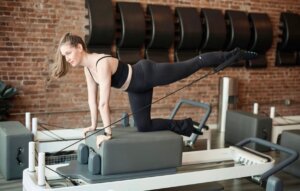
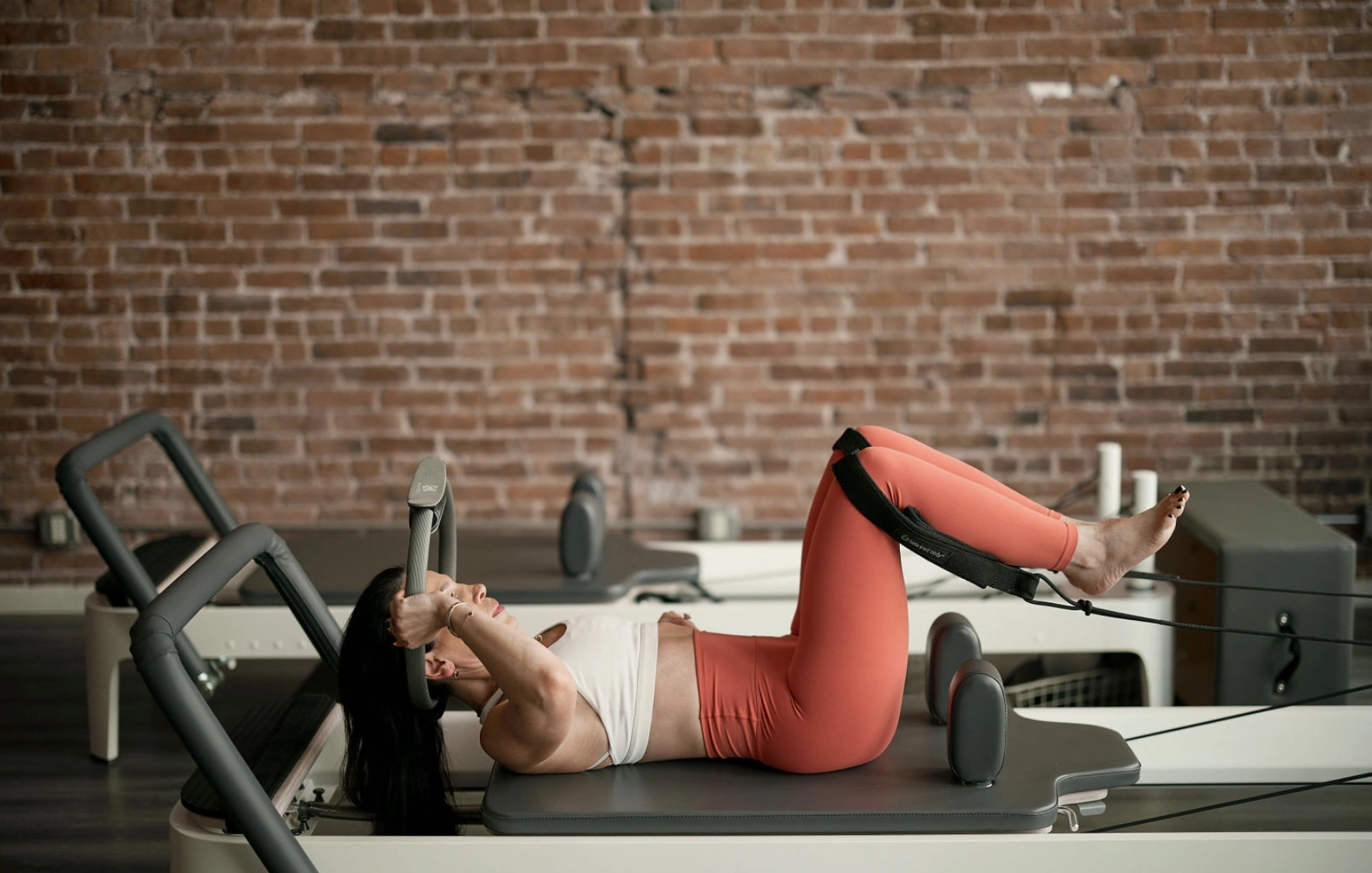
The reformer is one of the most effective tools for oblique training precisely because it demands what most gym exercises skip: anti-rotation under load, rotational control through a moving carriage, and stabilization in positions the body rarely encounters on a flat surface. Every time the carriage moves and your pelvis stays still, that’s your obliques working isometrically – the same function a Pallof press trains, built into the session automatically. Exercises like short spine, oblique work in straps, and seated rotation series target all five oblique functions within a single class. The spring resistance makes it possible to load rotation and anti-rotation without the spinal compression that weighted oblique exercises often create.
Should You Train Obliques Separately?
Should I train obliques separately? It depends on your current program. If your training already includes heavy compound lifts, carries, and rotation-based work, your obliques are getting trained. If your program is primarily machine-based or anterior-focused (lots of chest, quads, biceps), adding dedicated oblique work – 2–3 targeted exercises, 2x per week – will fill a significant gap.
The benefits of strong obliques extend well beyond aesthetics: lower back resilience, better rotational power, improved breathing mechanics under load, and genuine spinal stability that holds up when things get heavy or unpredictable.
FAQ
What are your obliques – and what’s an oblique muscle exactly? The oblique muscle is a paired group of abdominal muscles on the sides of the torso, divided into external obliques (outer layer) and internal obliques (beneath). Together they control rotation, lateral bending, and spinal stabilization.
Where are your obliques located? Along the lateral walls of the abdomen, running from the lower ribs to the pelvis and hip crest. They extend further around the torso than most people expect, connecting into the lower back fascia.
What’s an oblique crunch – does it actually work the obliques? A standard oblique crunch trains lateral flexion and does activate the external obliques. The limitation is that it ignores rotational and anti-rotational function. It’s a partial tool, not a complete oblique training strategy.
Are obliques important if I’m not an athlete? Yes. Oblique function is involved in virtually every daily movement that requires torso stability – lifting, carrying, reaching, breathing under effort. Weak obliques typically manifest as lower back overuse and postural compensation long before any athletic demand is placed on the body.
Find Out What Your Obliques Are Actually Capable Of
Oblique strength gaps don’t show up until the exercise demands it – and then they show up everywhere. If you want programming that trains rotation, anti-rotation, and lateral strength as a system – not as an afterthought – Book a class and find out what your obliques are actually capable of.
Try Reformer Pilates at BK Pilates in NYC
Put this into practice in a class at one of our five New York City studios: reformer Pilates in Flatiron, NoMad, Chelsea, Park Slope and Sheepshead Bay, Brooklyn. New to BK Pilates? Start with Camp Pilates: 7 days of unlimited classes for $89.