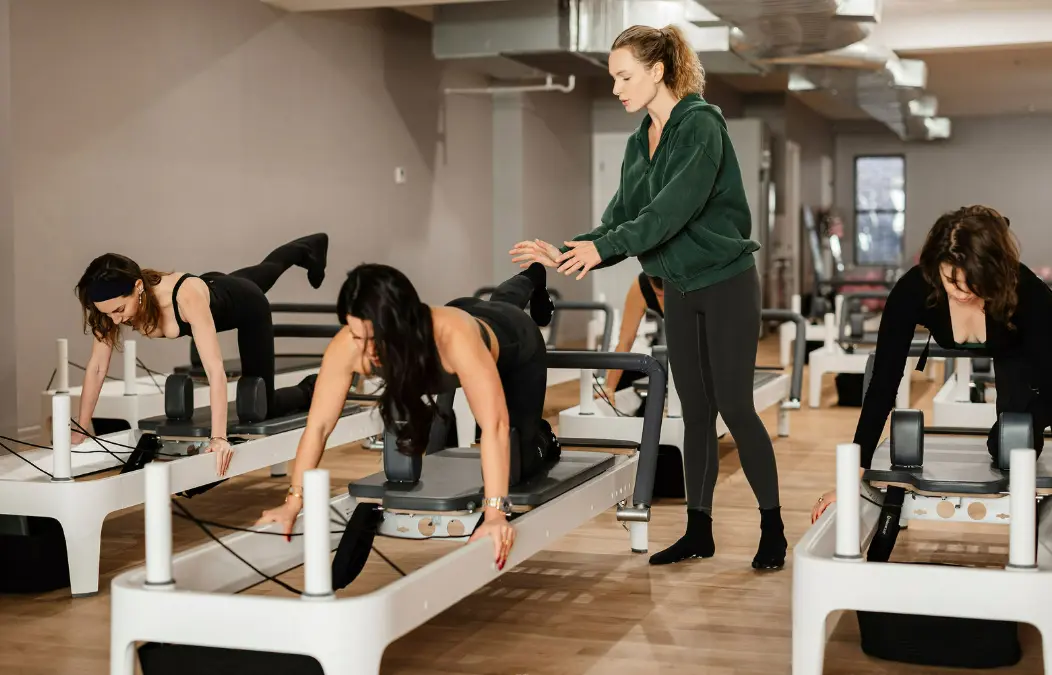
Your reformer session ends, you feel loose and tall for the rest of the day — and by the next morning, your hips are tight again and your neck is right back where it started. That gap between sessions is where most people lose the progress they just built.
The fix isn’t more studio time. It’s a short, consistent home stretching routine that keeps your body in the state your instructor just put it in. Below are 10 stretches — grounded in how physical therapists and pilates instructors actually program recovery — that take less than 15 minutes and require nothing but floor space.
Why the Days Between Sessions Matter More Than People Think
A single class can improve your range of motion for 24 to 48 hours. After that, the body starts drifting back toward its default patterns — the same forward-hunched shoulders, the same locked-up hips from sitting all day. This isn’t a flaw in the training; it’s simply how tissue adapts. Muscles and fascia respond to what you repeat most often, and for most people that’s still a desk chair, not a mat.
This is exactly why stretching exercises done consistently at home matter as much as the sessions themselves. A daily stretches habit, even a brief one, keeps the nervous system familiar with a longer range of motion, so each studio visit builds on real progress instead of re-teaching the same lesson.
What Actually Happens When You Stretch Consistently
Is stretching good for you in a measurable way, or is it just a pleasant habit? The honest answer sits in the middle. Static stretching alone won’t build strength, and it won’t replace the loaded, controlled work you do on a reformer. What it does deliver, when done consistently, is real:
- Reduced muscle tension — a slow hold signals the nervous system to relax a muscle that’s been guarding itself, which is why a tight hip flexor often loosens within a single 30-second hold.
- Better joint range of motion — daily mobility work keeps the tissue around a joint pliable, so the next time you load it — in a class or in daily life — it has somewhere to go.
- Lower injury risk during training — a body that moves through a full range at rest is less likely to compensate awkwardly under load.
Where stretching underdelivers is stress relief marketed as its main benefit. Plenty of people search for stretches for stress relief expecting a cure-all, but can stretching reduce stress? Somewhat — the slow breathing and forced pause help — but it’s a side effect of the practice, not the primary reason to do it.
The 10 Stretches: A Simple Home Routine
Work through these in order. Each one flows naturally into the next, so the whole sequence takes about 12–15 minutes and covers the areas that tighten up fastest between sessions: hips, hamstrings, lower back, shoulders, and neck.
- Hamstring Stretch (Standing or Seated) Sit on the floor with one leg extended, the other bent so your foot rests against the inner thigh. Hinge forward from the hips, keeping your spine long, until you feel tension along the back of the extended leg. This is the single most requested move in any hamstring stretches routine, and for good reason — tight hamstrings are often the hidden cause of a stubborn lower back. Hold: 30 seconds per side.
- Hip Flexor Lunge Stretch From a low lunge, drop the back knee to the floor and gently press the hips forward. Most people carry more tightness here than they realize, since sitting for hours keeps this muscle group in a shortened position all day. Of all the hip flexor stretches out there, this one requires the least setup and delivers the most noticeable release. Hold: 30 seconds per side.
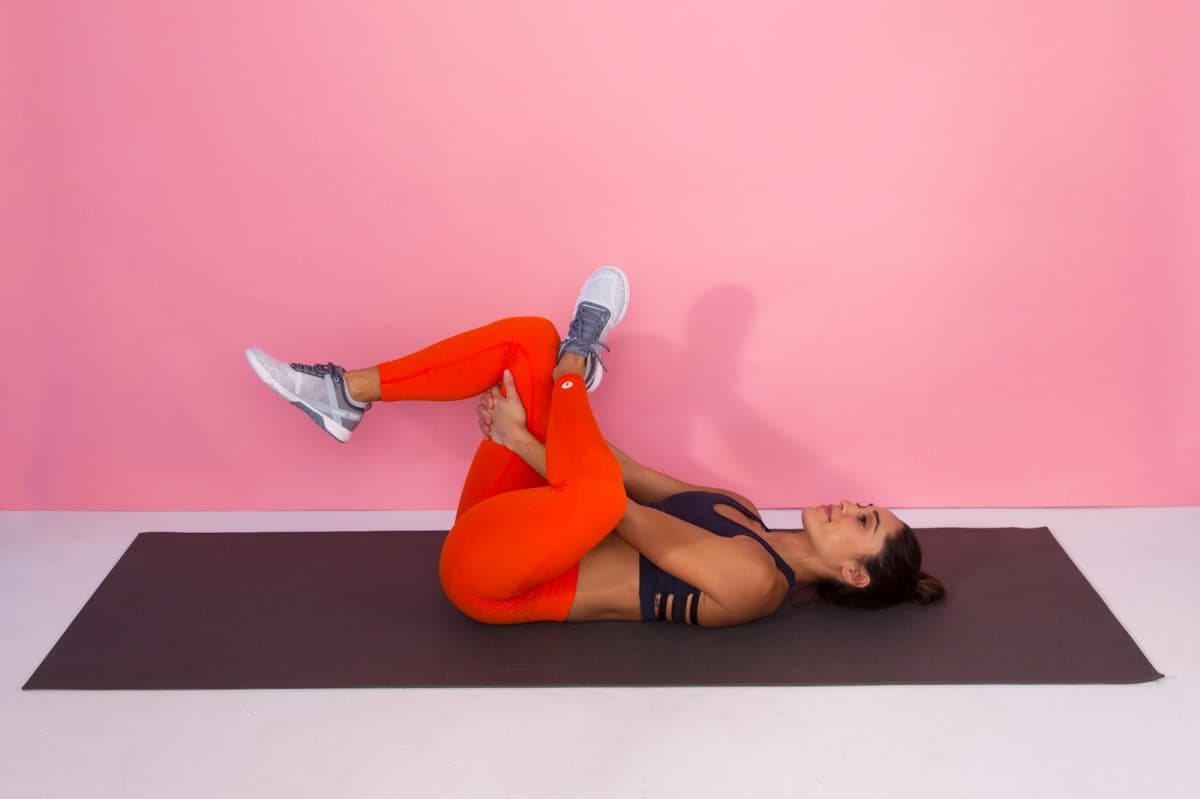
- Seated Figure-Four Stretch Sit tall, cross one ankle over the opposite knee, and lean forward slightly. This targets the outer hip and glute — a spot that rarely gets attention in a standard stretches for hips routine but is often the real culprit behind a tight lower back or knee that clicks during squats. Hold: 30 seconds per side.
- Child’s Pose Kneel with your knees wide, sit back toward your heels, and reach your arms forward along the floor. This is one of the most reliable stretches for lower back tension because it decompresses the spine without any active muscle work — you’re simply letting gravity do the job. Hold: 45 seconds.
- Cat-Cow On hands and knees, alternate between arching the spine up (cat) and dropping the belly while lifting the chest (cow). This gentle, moving stretch is a staple in any stretching routine for beginners because it teaches spinal awareness before anything more advanced. Perform: 8–10 slow cycles.
- Thread the Needle From all fours, slide one arm underneath your body and rest your shoulder and ear on the floor, letting your upper back rotate open. This move quietly doubles as one of the better stretches for neck pain, since the rotation releases tension that builds up between the shoulder blades and travels up into the neck. Hold: 30 seconds per side.
- Standing Quad Stretch Standing on one leg, pull the opposite heel toward your glutes, keeping your knees close together. A classic addition to any stretches for legs sequence, this one balances out the hamstring work from earlier in the routine. Hold: 30 seconds per side.
- Doorway Chest Stretch Place your forearm against a doorframe at shoulder height and gently rotate your body away. Anyone who spends the day at a keyboard will feel this one immediately — it’s one of the most effective stretches to relieve tension built up from the rounded-shoulder posture that hours of typing creates. Hold: 30 seconds per side.
- Seated Spinal Twist Sit with legs extended, bend one knee and cross it over the opposite leg, then rotate your torso toward the bent knee. This gentle rotation is a favorite among physical therapists for restoring mobility to a spine that’s been sitting still all day. Hold: 30 seconds per side.
- Legs-Up-the-Wall Lie on your back with your legs extended up a wall, arms relaxed at your sides. This is the quiet finisher — it drains tension from tired legs, slows the breath, and signals the nervous system that the session is over. It’s also one of the simplest stretches before bed if you’re winding the routine into your evening instead of your morning. Hold: 2–5 minutes.
Your Full Body Stretch Routine, At a Glance
Once you’ve practiced each move individually, run through this full body stretch routine as a single sequence three to five times a week — or reach for it as stretches for muscle recovery on the day after a harder-than-usual class:
- Cat-Cow — 10 cycles (warm-up)
- Hip Flexor Lunge Stretch — 30 sec/side
- Hamstring Stretch — 30 sec/side
- Standing Quad Stretch — 30 sec/side
- Seated Figure-Four Stretch — 30 sec/side
- Seated Spinal Twist — 30 sec/side
- Thread the Needle — 30 sec/side
- Doorway Chest Stretch — 30 sec/side
- Child’s Pose — 45 sec
- Legs-Up-the-Wall — 2–5 min
No rest needed between moves — the transitions themselves are the recovery. Most people notice looser hips and an easier time getting into deep stretches within the first two weeks of doing this consistently.
Stretching vs. Foam Rolling vs. Pilates: What Each One Actually Fixes
The stretching vs. pilates question (with foam rolling often thrown into the mix) comes up constantly, and each one solves a different problem. Knowing which tool fits which complaint saves a lot of wasted effort.
| Low Impact Training | High Impact Training | |
| Primary benefit | Joint-friendly strength, control, recovery | Power, speed, sport-specific conditioning |
| Recovery demand | Low — can be done on adjacent days | High — needs 24–48 hours before repeating |
| Injury risk | Minimal | Higher, especially without adequate recovery |
| Best frequency | 2–3x per week | 2–4x per week, sport-dependent |
| Cross training benefits | Maintains fitness while reducing joint load | Builds the specific adaptations the sport requires |
| Who it’s for | Every athlete, regardless of sport | Athletes actively training for performance or competition |
The takeaway: stretching keeps you loose day to day, foam rolling handles acute tightness after a hard session, and pilates is what actually builds the strength that makes the tightness show up less often in the first place.
Common Mistakes People Make When Stretching at Home
A routine this simple still gets undermined by a few predictable habits:
- Bouncing instead of holding. Ballistic bouncing doesn’t give the muscle time to actually release — it just triggers a protective contraction that works against the stretch.
- Holding your breath. Tension in the breath translates directly into tension in the muscle; a slow exhale during each hold makes the stretch noticeably deeper.
- Stretching cold. A few minutes of light movement — marching in place, arm circles — before diving into static holds reduces strain and improves the result.
- Skipping the routine on “off” days. The days without a studio class are exactly when tissue tends to tighten back up — that’s precisely when this stretches at home routine earns its keep.
Frequently Asked Questions
How often should you stretch? Daily is ideal for maintenance, but even three to four times a week produces a noticeable difference in range of motion within a few weeks.
Is stretching good for you if you already do pilates? Yes — stretching and pilates work together rather than compete. Pilates builds strength through controlled range of motion; stretching maintains that range on the days in between.
What are the best stretches for sore muscles after a workout? Gentle, static holds like the seated spinal twist and legs-up-the-wall work well post-workout, since they calm the nervous system rather than pushing the muscle further.
Can stretching reduce stress? It can help as part of a broader practice — the combination of slow breathing and forced stillness has a real calming effect, though it works best paired with sleep and movement rather than as a stand-alone fix.
Do I need any equipment for these stretches? No. Every stretch in this routine uses just floor space and, for one move, a doorway or wall — nothing else required.
Between Sessions Isn’t Downtime — It’s Part of the Training
These stretches keep your body in the range your instructor worked hard to open up. But stretching alone has a ceiling: it maintains mobility, it doesn’t build the strength that makes mobility last. That’s the gap reformer pilates stretches and full sessions are built to close — controlled, resisted movement through the exact range you’ve been stretching into on your own.
If you’ve been sticking to this routine and feeling the difference, the next step is simple: book a session at BK Pilates and let a reformer do what a stretch alone never can.