You eat what you’ve always eaten. You still go to your Tuesday class. Sleep is garbage lately, sure, but other than that? Nothing’s changed. And yet your favorite jeans have opinions about your waist now, and your knees sound like bubble wrap on the stairs at Union Square. That spin-plus-weights thing that worked for a decade has quit on you. Women in our 7 a.m. classes tell us this kind of thing all the time, usually while laughing about it, usually a little annoyed too. It’s real. Your hormones are moving the goalposts on muscle, on belly fat, on bone, so the way you train has to move with them. So we sat down and wrote out what we actually tell people when they ask us about the best exercise for menopause. Why we keep steering them toward the reformer. And the week we’d plan for them, which you can borrow.
Key takeaways
If you only read one paragraph, make it this one. There’s no single best exercise for menopause; it’s a week that has lifting, bone loading, balance and recovery in it. A reformer class covers three of those at once, and walks plus some dumbbells fill in the gap. Shoot for 2 or 3 Pilates or strength days and roughly 150 minutes of moderate cardio. If you’ve got osteoporosis, deep forward folds and loaded twists are out, extension and standing work are in. And belly fat? Can’t be spot-targeted, as much as we’d love to tell you otherwise.
What Happens to Your Body in Perimenopause and Menopause
Quick biology, we promise it’s relevant. Perimenopause usually starts mid-to-late 40s and hangs around roughly four years on average, though honestly anywhere from two to eight counts as normal, which is not super helpful if you’re trying to plan your life. Twelve straight months without a period and you’re officially in menopause. For American women the average age is 52.
Estrogen leaving the building explains most of it. What does that mean when you’re on a reformer or at the gym? Muscle goes faster than it used to. Don’t lift, and your strength, your balance and a slice of your metabolism go with it. Your bones lose their bodyguard, too, since that was one of estrogen’s jobs, and so after menopause density drops quicker and osteoporosis is suddenly a thing your doctor brings up. The fat that lived on your hips for 20 years packs up and moves to your stomach, sometimes without the scale moving at all, which feels deeply unfair. Then there’s the sleep stuff. Mood. Waking up at 3 a.m. soaked. All of that eats into recovery. And the pelvic floor gets weaker, which is the reason jumping jacks suddenly feel risky.
Now the part we like: training helps with all of it. Every item. It’s just about the mix.
What Is the Best Exercise for Menopause?
Hoping for one magic class? Us too, years ago. Doesn’t exist. The best exercise for menopause is a week that has a bit of everything in it: muscle-building, bone-loading, balance, and something to take your stress down a notch. If you like official numbers, the CDC wants 150 minutes a week of moderate cardio from adults and strength work on two or more days. For women in menopause, that strength bit is the part we’d circle in red pen.
Four buckets, basically:
- Strength. Two or three times a week. Keeps the muscle you’ve got and gives your joints some backup.
- Bone loading. Anything where your feet carry your weight: fast walks, standing exercises, lunges.
- Balance and core. Protects your back, keeps you upright on icy February sidewalks.
- Recovery. Mobility, breathing, actual sleep. Skip this bucket and the other three don’t land.
Best Exercise for Perimenopause
The best exercise for perimenopause uses those same buckets, with way more give, since perimenopause is chaos on a calendar. You feel great Tuesday and like a zombie Thursday. Plan for both versions of you. Slept? Go to the hard reformer class, or lift. Up at 2 a.m. sweating through the sheets? Walk instead, or do ten minutes on the living room floor. One perfect week won’t change anything. Six months of mostly-okay weeks will.
Why Pilates for Menopause Works So Well
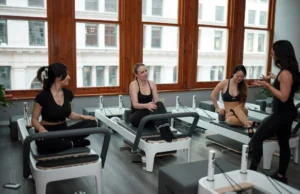
We’re biased, obviously. But Pilates for menopause really does cover a lot of ground in 50 minutes. The springs give you resistance, so you’re building strength. Core and balance get trained every single class. Your joints don’t take a beating. And because the method is so focused on breath, it slows you down, which, when you’re stressed and sleeping badly, is kind of the point.
It’s not just us saying it, either. In a 2025 randomized controlled trial, postmenopausal women between 45 and 65 did Pilates twice a week for 8 weeks; compared with a control group they reported fewer menopausal symptoms, better quality of life and better sexual function. It was a small study (30 women), so we won’t oversell it. It does match what we see in the studio.
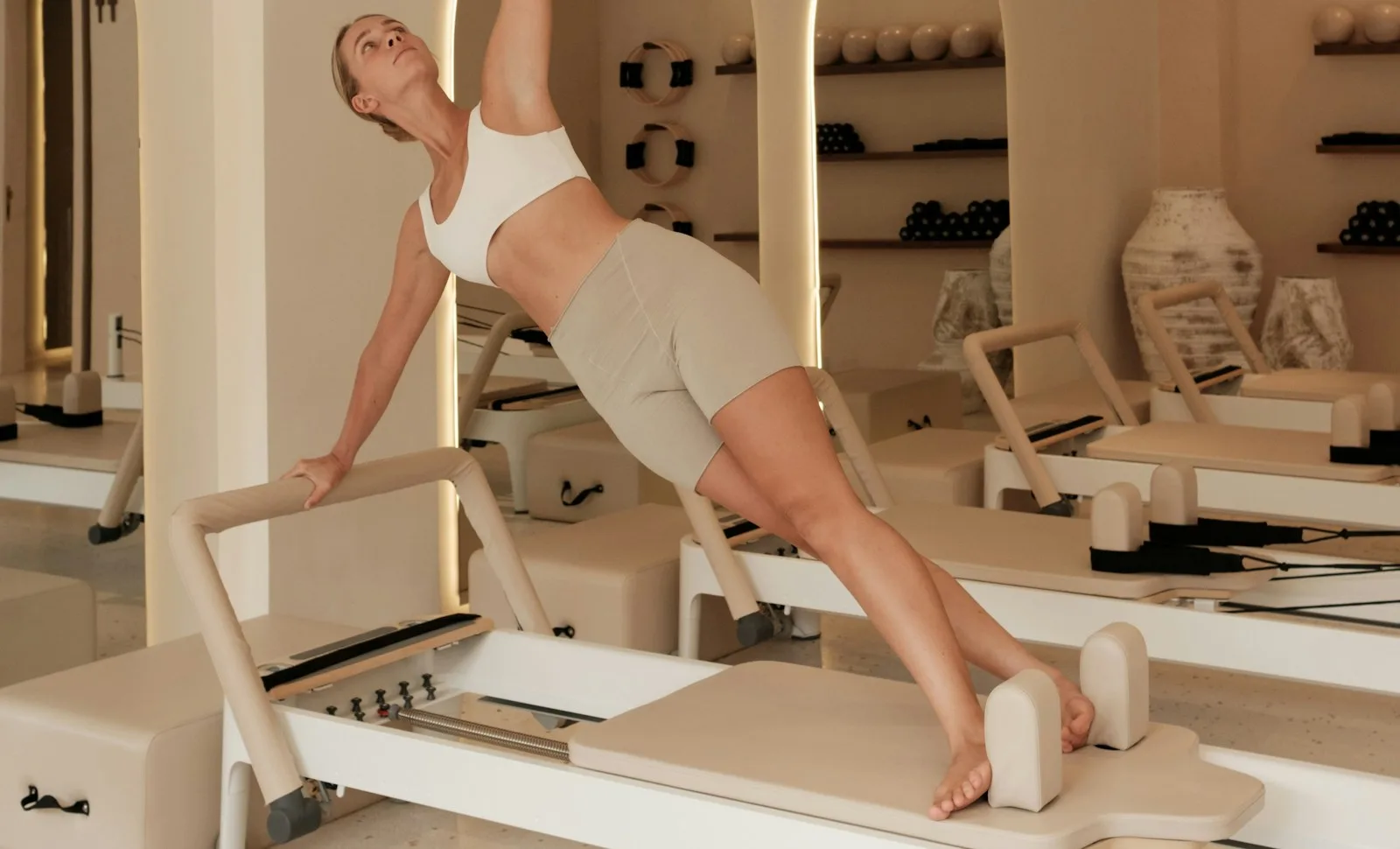
On the reformer specifically, you get strength without heavy weights, since springs let you add load slowly and safely, which is great if you’ve never lifted a barbell in your life. You get deep core and pelvic floor work, the muscles that hold up your spine and, yes, your bladder (our guide to pelvic floor engagement in Pilates goes deeper on this). You get better posture, because back extension work pushes against that forward slump that creeps in over the years; see Pilates for posture. And you get a break for your nervous system. We wrote about that in Pilates for stress relief.
Pilates for perimenopause works the same way, and if you’re still a few years out, now’s a great time to start. You’ll go into menopause with more strength and a better sense of how your body moves.
A Weekly Menopause Workout Plan
Here’s the menopause workout plan we’d hand a friend. Reformer Pilates, strength, cardio, recovery. Somewhere around 4 to 5 hours a week, which is doable even with a job and kids and everything. Move the days around however your life needs.
| Day | Workout | Time | Focus |
|---|---|---|---|
| Monday | Reformer Pilates class | 50 min | Full-body strength, core, posture |
| Tuesday | Brisk walk, hills or stairs if you can | 30 to 40 min | Cardio and bone loading |
| Wednesday | Strength training with weights or bands | 30 to 40 min | Legs, glutes, back, arms |
| Thursday | Brisk walk + 10 min mobility | 40 min | Cardio and recovery |
| Friday | Reformer Pilates class | 50 min | Core, balance, standing work |
| Saturday | Longer walk, hike or bike ride | 45 to 60 min | Cardio, time outdoors |
| Sunday | Rest, stretching or gentle mat work | 15 to 20 min | Recovery and sleep |
Hate the gym and know Wednesday’s never happening? We get it, a lot of our clients feel the same. Make it a third reformer day then; it counts as strength. And if you’re torn on how many classes a week, how often you should do Pilates walks you through it. Want to lift too? Read how to combine Pilates and strength training first so you don’t burn out.
Perimenopause Workout: How to Adjust the Plan
A perimenopause workout plan that can’t bend will break. We tell clients to lock in the two Pilates classes and let the rest float. Wiped out? Do the short walk, flat route. Feel like a superhero? Heavier springs, extra set, power-walk it. Some of our clients keep a little note in their phone, sleep hours and a 1-to-5 energy score, and after a month a pattern usually jumps out.
Best Reformer Exercises for Menopause
These show up in almost every reformer class we teach, and they’re especially good during menopause. Your instructor sets the springs and gives you the version that fits you.
- Footwork. You’re on your back pushing the carriage away with your legs. Sounds simple. It builds a lot of leg and hip strength and sets up your alignment from the ground up.
- Bridging. Feet on the bar, hips up. Glutes and hamstrings, the muscles that look after your lower back and hips.
- Standing lunges and side splits. Stand on a moving carriage and two things happen: your bones are carrying load, and your balance gets a wake-up call. People wobble. It’s fine. Everyone wobbles.
- Seated rowing and the arm series. Sit tall, pull and press against the springs. Upper back, shoulders, arms.
- Swan and back extension. Face down, chest lifts. This one’s a posture favorite of ours because it strengthens the muscles running along your spine.
- Side-lying leg series. Your outer hips and glutes, aka the muscles that save you on the cracked sidewalks of Park Slope.
- Planks and kneeling work. Core and shoulders, no crunching of the spine.
If you want some cardio without the pounding, jumpboard Pilates happens on the same machine.
Pilates for Osteoporosis: What Is Safe and What to Skip
Pilates for osteoporosis? Can be great. With changes. We want muscle around the spine and hips and better balance, minus the kinds of load a fragile spine hates. Rounding forward over and over is the big one; it’s been tied to back pain and fractures, which is why every “avoid with osteoporosis” list puts it near the top.
What’s usually safe and actually helpful: back extension work like swan and other prone exercises, standing work on the reformer (lunges, balance stuff), footwork and bridging with a neutral spine, seated arm work with a tall spine, and side-lying leg work.
And what we’d usually swap out: roll-ups, roll-downs, teasers (all deep spinal flexion), rolling like a ball and its cousins, crunchy ab stuff like the hundred with your head up, big or loaded twists, and forward folds such as spine stretch forward.
“Tell your instructor about osteoporosis or osteopenia, every time, even if it feels awkward. Get your doctor’s go-ahead too. If it were our mom, we’d book her a private first so she learns the safe versions without 8 other people around, and then she’d join a group.”
– Instructor BK Pilates
Pilates for Bone Density
Does it help bone density? Some, yes. Muscles pull on bone when they work, and Pilates builds those muscles; posture improves; falls get less likely. But bones are kind of simple creatures, they respond best to weight and impact. So Pilates for bone density works best alongside standing reformer work, stairs or quick walks, and a little lifting.
Menopause Belly Fat Exercises: What Actually Works
Hard truth first. There’s no exercise that burns fat off your belly specifically. You could do crunches every night for a year and the fat that shows up around your middle during menopause wouldn’t care. What works is changing the whole body.
Muscle first. More of it means your body handles energy better, and lifting plus reformer are the tools. Then steps, every day; boring, we know, but your step count matters nearly as much as the workouts. Then the deep core. Pilates goes after the transverse abdominis, that wraparound muscle that acts like a corset you never have to take off, and a lot of women notice their waist feels tighter well before the scale says anything (side note, here’s what your obliques do). Last, sleep and stress. When those two are a mess, belly fat digs in.
So the best menopause belly fat exercises? The ones you’ll keep doing. Full-body strength, reformer core work, a lot of walking. If you’re wondering what Pilates can realistically do for weight, read does Pilates burn calories.
Pilates vs Strength Training for Menopause
Doctors recommend strength training for menopause constantly, and for good reason. It’s one of the best things you can do for muscle and bone. Where does that leave Pilates? Right next to it. You don’t have to choose.
| Reformer Pilates | Weight training | |
|---|---|---|
| Muscle strength | Yes, with spring resistance | Yes, easier to add heavy load |
| Bone loading | Moderate, more with standing work | High, especially with heavier lifts |
| Core and pelvic floor | Excellent | Depends on technique |
| Balance and posture | Excellent | Moderate |
| Joint-friendly | Very | Yes, with good form |
| Good for beginners | Very, with instructor guidance | Yes, best with a coach |
“The combo we see working again and again: two reformer classes, one or two lifting sessions, every week. Reformer teaches you to move well and fire your core properly. The barbell lets you go heavy, and bones like heavy.”
– Instructor BK Pilates
Only room for one? Choose the one you won’t skip. Sounds like a cop-out. It isn’t. There’s a wider comparison in Pilates vs gym: long-term results.
Pilates for Women Over 40 and Over 50
Pilates for Women Over 40
Pilates for women over 40 is groundwork. You’re building the base before menopause shows up uninvited: a core that actually switches on, some extra lean muscle, and a spine that’s recovering from ten years of laptop slouch. And don’t let anyone tell you it has to be gentle at 40-something. Heavy springs, standing work, fast flows, bring it.
Pilates for Women Over 50
Pilates for women over 50 leans more into bones and balance and being nice to your joints. Not easy, though! Still hard work, just with more attention on form. If we had to pick one way to stay strong after 50 safely, Pilates over 50 would be high on the list, because each move can be made harder or easier on the spot. If you’re 65+ or coming back after years off, check out our guide to Pilates for seniors.
FAQ
What is the best exercise for menopause belly fat?
No one move. Lift or do reformer 2 to 3 times a week, walk daily, and work on sleep and stress. Together, that works.
Is Pilates enough exercise during menopause?
Covers strength, core, balance, posture. Bones want a little extra, so throw in brisk walks and maybe one or two heavier lifting days.
How often should I do Pilates during perimenopause?
Aim for 2 or 3 times a week. On a rough day, still come, just ask for lighter springs instead of skipping.
Is Pilates safe if I have osteoporosis?
Usually, if it’s adapted. No deep forward bends, no rolling, no loaded twists; lots of back extension and standing work. Get your doctor’s okay first and let your instructor know.
Is it too late to start Pilates at 50 or 60?
Nope. Because everything can be scaled, Pilates is one of the safer ways to start strength training later in life. A private session or a beginner class is the easiest way in.
When to Talk to Your Doctor First
Exercise is safe for most women in menopause. Still, get your doctor’s input before you start if you:
- have been diagnosed with osteoporosis or osteopenia, or have had a fracture;
- have heart disease, high blood pressure or get dizzy;
- have pelvic organ prolapse or leak a lot during exercise;
- haven’t worked out in a long time.
This article is general information and isn’t a substitute for medical advice.
Start Your Plan With Us
At BK Pilates, a reformer Pilates studio in NYC, our instructors work with women at every stage of perimenopause and menopause. Classes are small, every exercise has options, and we always ask about injuries and conditions before you start. You’ll find us in Flatiron, NoMad, Chelsea, Park Slope and South Brooklyn, and at our studios in North Carolina. Not sure where to begin? Book a private and learn the basics safely, or try Camp Pilates, 7 days of unlimited classes for $89. Everything’s on our pricing page. Then book a reformer class and call it day one.