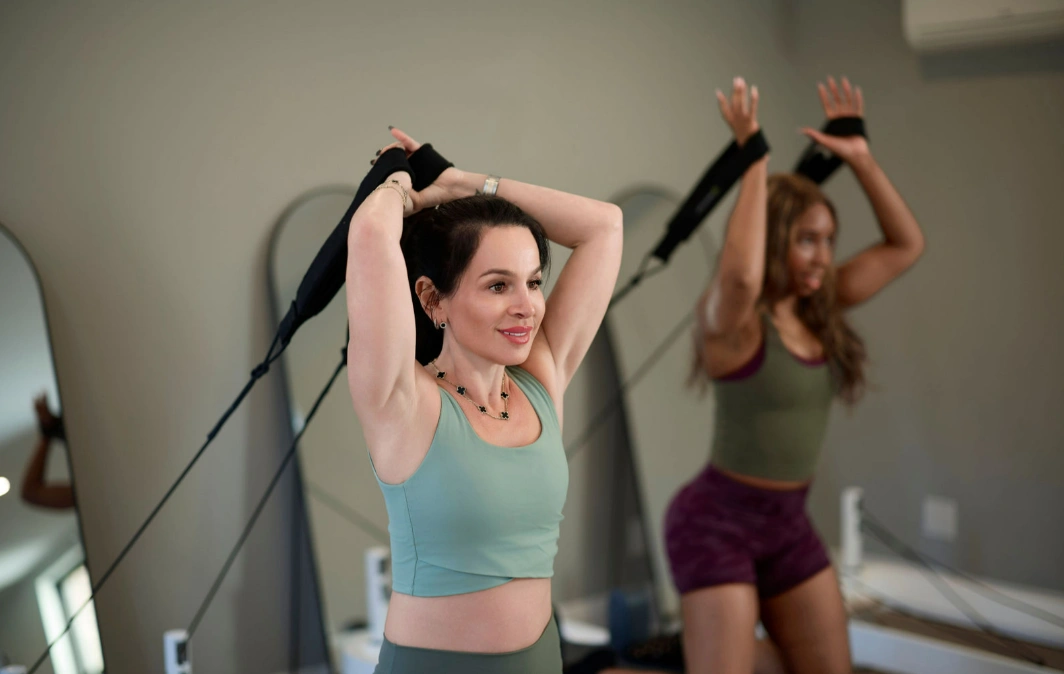
Core work is often mentioned when people talk about Pilates, but not always explained in a way that feels practical. Many students come to class expecting to “work their abs,” and leave wondering why the exercises felt subtle – or why they didn’t feel much at all.
That’s because Pilates approaches the core differently. Instead of pushing for burn or fatigue, it focuses on how the body organizes itself during movement. When the core does its job well, everything else – balance, posture, even breathing – tends to improve alongside it.
This article breaks down 12 Pilates core exercises that are commonly taught in both mat and reformer classes. It is not to say that you are better or worse than someone else, but so you know what exercises to choose according to where you are in your body. In reviewing the moves, we will also talk about what each exercise targets and how to tell whether you’re using your core to help perform it or simply being pulled along.
Why Pilates Exercises Are So Effective for Core Strength
Pilates’ core strengthening exercises differ from traditional fitness routines for the abs. In a fitness routine, the abs are usually isolated as you crunch and crunch away. Not so in Pilates.
In Pilates, your core isn’t just about your tummy. The muscles of your core go beyond just the abs, and help stabilize your spine, pelvis and rib cage while still allowing for movement in arms and legs. What makes Pilates exercises for core strength so special? They work deep muscles instead of the rectus abdominis that’s exclusively trained when we do crunches, sit-ups and other traditional ab exercises They focus on control rather than speed They incorporate breath, alignment and efficiency in their movement mechanics They lessen the likelihood of adding stress to your lumbar spine.
Pilates core moves are quite different from crunches.Crunch moves tend to compress the spine while Pilates movements emphasize length, support and balance. This is especially ideal for beginners or anyone with back issues. By the time you finish this article, you’re going to know exactly what: the Pilates exercises and routines are that work for your core how to make a good one set of criteria for how to perform every movement with confidence and control.
Read more about how Pilates differs from traditional strength training.
How Your Core Works in Pilates
Talking about core stability Pilates exercises, it is about the way the body makes support starting from the inside.
Your Pilates core includes:
- Transverse abdominis is the deep muscle like a corset that wraps your waist.
- Obliques responsible for rotation and side bending.
- Pelvic floor – working together with breath and deep abs.
In Pilates, strength comes from the connection of three elements:
Breath + Alignment + Control
This coordination allows you to stabilize the spine without gripping or tension. That’s why Pilates core exercises are often recommended for people seeking core strength with lower back support – the system works with the body, not against it.
How to Use This Pilates Core Exercise List
This list is designed to meet you where you are.
How to choose your level
- If you’re new to Pilates or returning after a break – start with Beginner Pilates Core Exercises
- If you already practice consistently – explore Intermediate
- If you feel confident with control and coordination – try Advanced
How many reps?
- 6–10 controlled repetitions
- Or 30–45 seconds of mindful movement
When to practice
- As part of a full Pilates class
- As a focused Pilates core workout
- Or as a short 10–15 minute core activation routine
The first piece of advice for beginners states that they should stop their current workout when they begin to feel their neck and back muscles becoming tense. Pilates should not cause any pain even though it presents some challenges for students.
Beginner Pilates Core Exercises
The very basic Pilates core centered exercises are a must and they will assist the beginner to easily locate and use the core muscles without putting a strain on the neck and back.
Pelvic Curl
Pilates core activation · Lower back support
What it works:
Deep abs, glutes and articulation of the spine
Steps:
You need to lie down on your back with your knees bent and your feet touching each other. You should inhale to prepare yourself and exhale while you turn your body to one side. Breath in and return to the original position. At last, breathe out and roll to the other side.
Common mistakes:
- Pushing through the feet
- Over-arching at the top
Modification:
Keep the movement small and focus on breath and control.
Modified Hundred
Pilates breathing core · Beginner ab exercises
What it works:
Core endurance, breath control
How to do it:
Lie on your back with your knees bent and your feet positioned flat on the mat. The exercise requires you to raise your arms while you inhale for cinco counts and then exhale for cinco counts.
Common mistakes:
- Tension in neck and shoulders
- Holding breath
Modification:
Keep head down or legs tabletop.
Single Leg Stretch
Mat Pilates core exercises · Core control
What it works:
Deep abs, hip stability
How to do it:
From the tabletop, extend one leg while hugging the other. Switch legs with control.
Common mistakes:
- Pulling the knee aggressively
- Losing pelvic stability
Modification:
Keep your head on the mat.
Double Leg Stretch (Bent Knees / Arms Only)
Pilates core workout beginner
What it works:
Anti-extension core control
How to do it:
Extend arms only or keep knees bent as you reach away, then return with control.
Modification:
Reduce range of motion.
Read more in our beginner’s guide to Pilates and learn how to build strength safely from the very first class.
Intermediate Pilates Core Exercises
These intermediate Pilates core exercises challenge coordination, balance, and dynamic stability.
Rolling Like a Ball
Pilates core balance · Spinal control
What it works:
Core coordination, balance
How to do it:
Balance behind sit bones, roll back to shoulders and return without collapsing.
Single Straight Leg Stretch
Pilates abs and core
What it works:
Lower abs, hamstrings, control
Modification:
Bend the extended leg slightly.
Criss-Cross
Pilates obliques · Rotational core exercises
What it works:
Rotational control
Tip:
Rotation comes from ribs, not elbows.
Pilates Plank
Core stability Pilates exercises
What it works:
Anti-extension strength, shoulder stability
Modification:
Lower knees to the mat.
Advanced Pilates Core Exercises
Advanced Pilates core exercises require strength, precision, and full-body control.
Side Plank
Pilates oblique exercises
Focus:
Lateral stability
Swan Prep
Pilates spine support
Focus:
Posterior chain + core balance
Teaser Prep
Teaser Pilates core
Focus:
Controlled lift, not momentum
Full Teaser
Advanced Pilates abs
Focus:
Strength, balance, breath coordination
Quick Reference: Pilates Core Exercises by Level
| Level | Exercises |
| Beginner | Pelvic Curl, Modified Hundred, Single Leg Stretch, Double Leg Stretch |
| Intermediate | Rolling Like a Ball, Single Straight Leg Stretch, Criss-Cross, Pilates Plank |
| Advanced | Side Plank, Swan Prep, Teaser Prep, Full Teaser |
Frequently Asked Questions About Pilates Core Exercises
Is Pilates actually worth it for core strength?
Here’s the thing: Pilates isn’t about that “burn” you get from doing a thousand crunches. It’s more than that. It’s hitting the inner structure that keeps your spine happy and your posture straight. You’re not leaving the classroom dripping with sweat. You know you’re doing it when you’re in the grocery store checkout line standing feeling: you’re looking forward to it this time.
Can a total beginner do this task?
Honestly, Pilates is a beginner’s best friend. It’s not about flexibility; it’s about learning to move without stressing your body out. Most beginner movements in Pilates are slow. Why? Well, your brain needs to catch up with what to activate first before you begin with any craziness.
How many times per week do I show up?
Consistency will always win against intensity, every single time. Aim for 2-4 sessions. You don’t need to crush yourself every day because Pilates doesn’t rely on muscle failure. A few short, focused sessions a week will do more for you than one “heroic” workout that leaves you sore for ten days.
What if I have lower back pain?
That’s actually why a lot of people start Pilates in the first place. Most back pain comes from asking your back muscles to do a job they weren’t designed for. Pilates teaches your core to take over that workload. Just a heads-up. If your back is really acting up, grab an instructor. Precision is what makes the pain go away.
How is this different from regular ab workouts?
Traditional ab workouts are kind of a one-trick pony – lots of folding yourself in half (aka crunches). Pilates works in 360 degrees. You’re twisting, extending, and staying still while everything else moves. It’s about functional control, not just repetitive motion.
Build a Strong Core with Pilates at BK Pilates
Core strength in Pilates develops quietly. It gets built by repetition, attention, and tiny little adjustments that usually are un noticeable from the outside. And these little things over time, they just build up in a way that will shift how you feel in your body not just during class but in life. These Pilates core exercises can act as a template to your practice, whether you are practicing at home or just want to work on mastering something that you feel like got away from you in the studio. Still the experience of moving with guidance-listening for the cues, the corrections, making adjustments as we go, for instance-can foster a deeper level of understanding.
At BK Pilates, we view core work as an ongoing conversation with the body. One that evolves as strength, awareness, and confidence grow.