Most people walk past a bare wall a dozen times a day without ever considering it a piece of fitness equipment. That’s the mistake. A wall provides something a yoga mat never can: a fixed, unmoving surface that lets your muscles work against real resistance without a single dumbbell in the room.
This guide breaks down what a wall workout actually is, whether it delivers real results, and exactly how to build one from scratch — even if you’ve never trained a day in your life.
What Is a Wall Workout? (And Why Everyone’s Calling It Wall Pilates)
This is exactly what it sounds like: a series of bodyweight exercises performed with your back, hands, or feet pressed against a wall for support, resistance, or alignment feedback. No bands, no weights, no bench — just a flat vertical surface and your own body weight.
Over the last year, most of this training method has been rebranded online as wall Pilates, and the overlap is real. Both use the wall the same way: as a stability tool that forces slow, controlled movement instead of momentum-driven reps. If you’ve seen a “28-day wall Pilates challenge” floating around social media, you’ve already tried this — just under a more marketable name.
What makes wall exercises genuinely useful isn’t the branding. It’s the constant feedback. A wall doesn’t let your lower back arch during a bridge or your knees cave during a squat the way an open floor does. That built-in correction is exactly why physical therapists have used wall-supported movement for decades, long before it had a hashtag.
Is Wall Pilates Effective? What Actually Happens When You Train Against a Wall
Is wall Pilates effective, or is this just a trend that looks good on a phone screen? The honest answer: it depends entirely on what you’re training for.
For building isometric strength, improving posture, and reintroducing movement to a body that’s been sedentary, wall training is genuinely effective. Holding a static wall hold for 45 seconds recruits the quads, glutes, and core in a way that’s measurably harder than it looks — ask anyone who’s tried it for the first time and stood up shaking.
What wall training won’t do is replace progressive overload. Your body adapts to a fixed resistance level quickly, which is why most serious programs treat wall work as a foundation, not a ceiling. The real wall Pilates benefits show up in three specific areas:
- Postural correction — wall-based holds retrain the body to stack the ribs over the pelvis instead of collapsing into a forward slouch.
- Joint-friendly strength building — the wall removes impact, making it a safe entry point for beginners, older adults, or anyone returning from injury.
- Mind-muscle connection — with no momentum to cheat with, you’re forced to actually feel the muscle working, which is exactly what builds control over time.
Wall Training vs. Traditional Home Workouts
Before committing to a wall-based routine, it helps to see exactly how it stacks up against the alternatives most beginners consider first.
| Wall Workout | Floor Bodyweight Workout | Home Weight Training | |
| Equipment cost | $0 | $0–$20 (mat) | $100–$500+ |
| Space required | One wall, 3×3 ft | Open floor space | Storage for weights |
| Joint impact | Very low | Low–moderate | Moderate–high |
| Beginner friendly | Excellent | Good | Requires guidance |
| Progression ceiling | Moderate | Moderate | High |
| Best for | Posture, isometric strength, injury recovery | General conditioning | Long-term muscle building |
The takeaway: this style of training wins on accessibility and joint safety, but it isn’t designed to be a permanent strength ceiling — more on that later.
Wall Pilates for Beginners: 7 Core Exercises to Master First
If you’re new to this style of training, don’t try to copy an advanced 20-minute wall Pilates workout on day one. Start with these seven moves, master the form, and build volume from there. This is the same progression order we walk new clients through in their first wall Pilates session.
1. Wall Sit
Stand with your back flat against the wall, feet shoulder-width apart and about two feet from the wall. Slide down until your thighs are parallel to the floor, knees stacked over ankles. Hold. This single move — the wall sit — is the single best gauge of quad and core endurance you’ll find without equipment.
Start: 3 sets of 20–30 seconds.
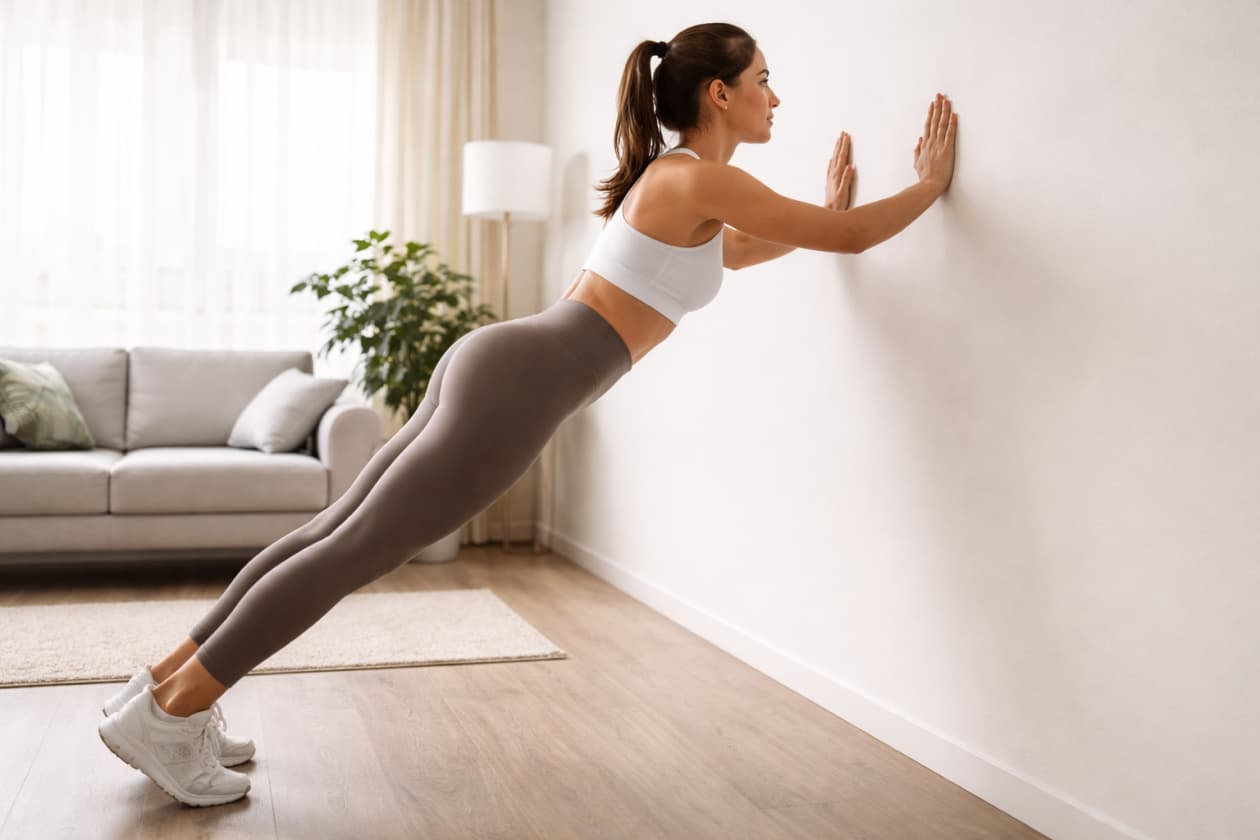
2. Wall Push-Ups
Face the wall, hands slightly wider than shoulder-width, arms extended. Lower your chest toward the wall, elbows at 45 degrees, then press back. Wall push ups are the standard entry point for anyone not yet ready for a floor push-up — the reduced angle means less bodyweight resistance, not less benefit.
Start: 3 sets of 10–15 reps.
3. Wall Angels
Stand with your entire back — head, shoulders, spine — flat against the wall, arms bent at 90 degrees like a goalpost. Slowly slide your arms up overhead and back down without losing wall contact. The wall angels exercise exposes tight shoulders almost instantly; if your arms lift off the wall, that’s the mobility gap you’re working to close.
Start: 3 sets of 10 reps.
4. Wall Plank
Place your forearms on the wall at chest height, walk your feet back until your body forms a straight incline line, and hold. A wall plank is a gentler entry point than a floor plank while still training the same anti-extension core strength.
Start: 3 sets of 30–45 seconds.
5. Wall Squat
Similar setup to the previous hold, but performed as a moving rep instead of a static hold — squat down, pause, drive back up. The wall squat teaches proper knee tracking before you ever add a barbell.
Start: 3 sets of 12–15 reps.
6. Wall Bridge
Lie on your back, heels pressed flat against the wall, knees bent to roughly 90 degrees. Lift your hips until your body forms a straight line from knees to shoulders. The wall bridge intensifies glute activation because the wall gives your feet something firm to drive into.
Start: 3 sets of 12 reps.
7. Wall Climbers
From an inclined plank position against the wall, alternate driving your knees toward your chest at a controlled pace. This adds a light cardio element to close out the session without any impact on the joints.
Start: 3 sets of 20 seconds.
Your Full Body Wall Workout Routine
Once you’ve practiced each move individually, string them together into one session. This full body wall workout takes about 18–20 minutes and covers every major muscle group:
- Wall Angels — 2 sets of 10 (warm-up)
- Wall Sit — 3 sets of 30 seconds
- Wall Push-Ups — 3 sets of 12 reps
- Wall Squat — 3 sets of 15 reps
- Wall Plank — 3 sets of 40 seconds
- Wall Bridge — 3 sets of 12 reps
- Wall Climbers — 2 sets of 20 seconds
Rest 30–45 seconds between sets. Run through this wall Pilates workout three times a week and you’ll notice your hold time increasing within the first two weeks — that’s the clearest sign the program is working.
Wall Pilates for Weight Loss: The Honest Answer
Wall Pilates for weight loss is one of the most searched claims around this trend, and it deserves a straight answer: wall training alone won’t burn significant calories compared to running or cycling. A 20-minute session burns roughly 100–150 calories depending on intensity — meaningful, but not a weight-loss engine on its own.
Where it does help is consistency. Because the barrier to entry is zero — no gym, no equipment, no commute — people actually stick with it. And this approach works best as one piece of a broader plan: a slight calorie deficit, better sleep, and enough protein, with wall training providing the strength stimulus that keeps muscle mass intact while the scale moves.
Targeted Wall Training: Abs, Posture, and Back Pain
Beyond the full routine, three specific goals come up constantly with clients trying wall training for the first time.
- Wall Pilates for abs: This hold, combined with a slow wall-supported bicycle motion, targets the deep core rather than just the surface six-pack muscles, building the kind of stability that shows up in every other lift.
- Wall exercises for posture: A simple standing wall lean — heels, glutes, shoulders, and head all touching the wall for 60 seconds daily — retrains the body to stop defaulting into a rounded, screen-hunched position.
- Wall exercises for back pain: A gentle wall-supported cat-cow stretch decompresses the lower spine without any load, which is why physical therapists frequently prescribe this kind of work during early-stage recovery. Anyone with an existing injury should still confirm these movements with a doctor or physical therapist first.
Common Mistakes Beginners Make at the Wall
Even a simple routine like this gets undermined by a handful of predictable errors:
- Rushing the hold times. A 10-second hold that’s supposed to be 30 doesn’t build the same endurance — the last ten seconds are where the adaptation happens.
- Letting the lower back arch off the wall. This is the single most common form break during static holds and mobility drills, and it shifts load away from the muscles you’re trying to train.
- Skipping warm-up entirely. Cold shoulders or a cold lower back before these movements increases strain for no benefit.
- Treating every session as maximum effort. Isometric holds fatigue the nervous system faster than people expect; two rest days between intense sessions matter just as much as the workout itself.
Small corrections here — more than any new exercise variation — are what separate people who see results in a month from people who plateau in a week.
When a Wall Isn’t Enough Anymore
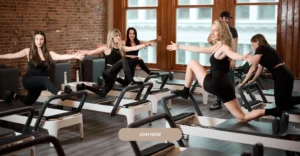
A wall is an excellent starting point, but the resistance never changes. Once your hold times hit two minutes and your push-ups stop feeling like work, your body needs a new stimulus to keep adapting — and that’s exactly the gap reformer Pilates was built to fill.
The spring-loaded resistance on a reformer does what a wall physically can’t: it scales up as you get stronger, week after week, without ever adding impact to the joints. It’s the same isometric, control-focused training philosophy — just with a resistance system that grows with you instead of staying fixed.
Frequently Asked Questions
Does this actually build real strength, or is it just for beginners? It’s genuinely effective for beginners, for postural correction, and for anyone easing back into movement after time off. For advanced strength goals, it works best as a supplement to progressive resistance training rather than a replacement for it.
What are the main wall Pilates benefits compared to a regular bodyweight workout? The wall adds constant feedback and support that a floor workout doesn’t provide, which typically means better form, lower joint strain, and faster correction of common mistakes like arching the back or letting knees cave inward.
How often should I train this way? Three sessions a week, with a rest day between each, is enough to see noticeable strength and posture improvements within the first month.
Do I need a mat or any equipment at all? No. A flat wall and about three square feet of floor space is all this training requires — that’s the entire appeal.
Can wall exercises help with existing back pain? Many wall-supported movements are low-impact enough to help, but anyone with an existing back condition should clear specific exercises with a doctor or physical therapist before starting.
Ready to Take It Further?
A wall will always be free, and it will always be there. But if you’ve outgrown what a fixed surface can offer and want resistance that builds with you, book a class at BK Pilates and see what the same training principles look like on a reformer.