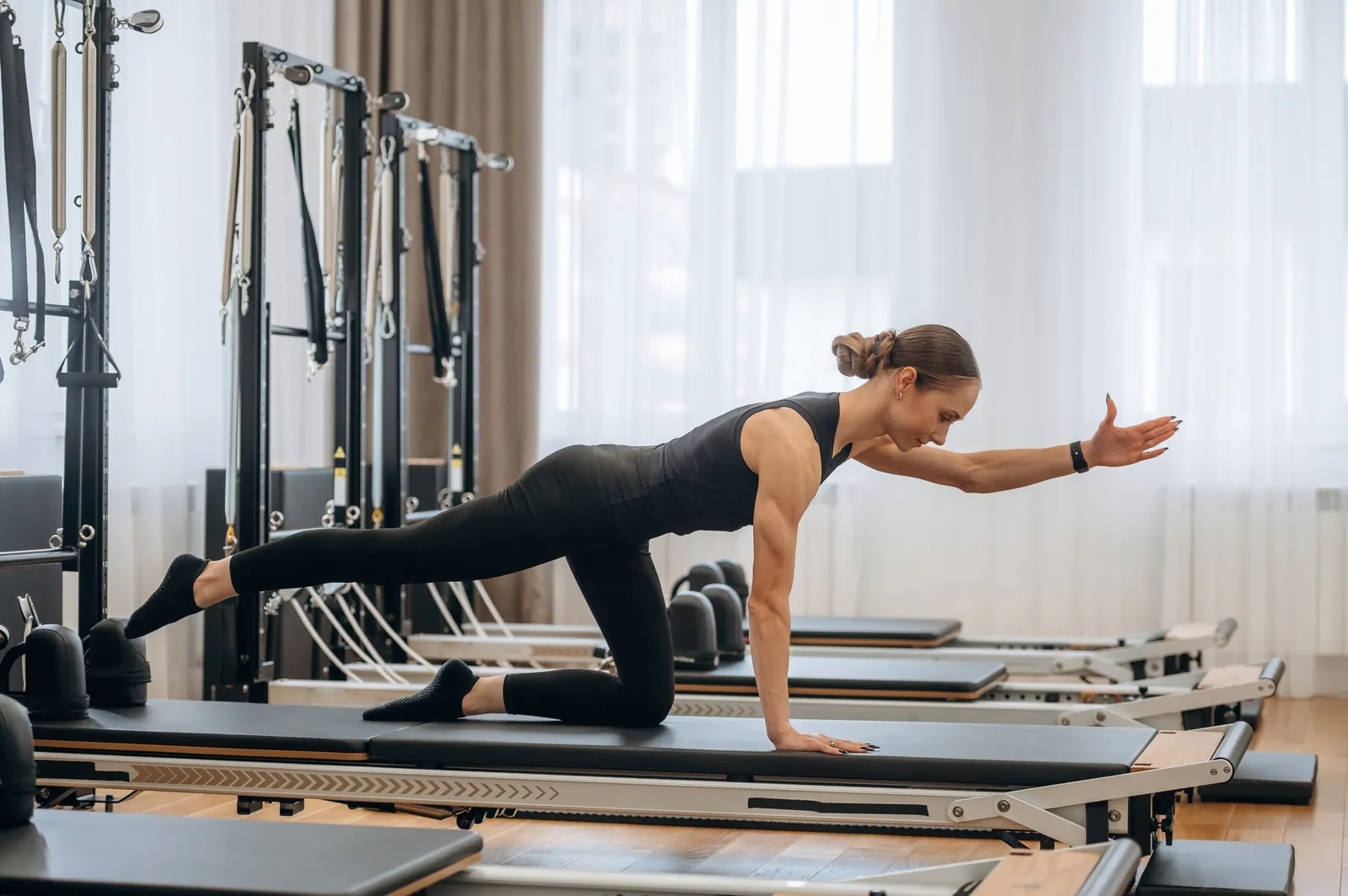
Open a studio schedule for the first time and, no offense to whoever wrote it, it reads like a menu in a language you only half speak. Classical. Contemporary. Reformer, tower, hot, fusion, clinical. If you’re new, that’s a lot, and we’ve watched plenty of people stand at our front desk squinting at the board. Here’s the thing though: every single one of them traces back to one guy, Joseph Pilates, and a method he built about a hundred years ago. They just took different turns along the way, different equipment, different formats. Below: the main types of Pilates, what each one’s like when you’re actually lying on the machine, and how to pick.
Where All Types of Pilates Come From
Joseph Pilates was a German-born trainer who built his method in the early 1900s and gave it a name nobody uses anymore, Contrology (his idea: the mind runs the body). By the 1920s he and Clara, his wife, had a studio in Manhattan, a few miles from where we teach now. Dancers came, athletes came, regular New Yorkers came, and they all trained on machines he’d designed himself. Everything you see on a schedule today grew out of that one room.
Then his students opened their own studios. New teachers brought in new research. Things split into branches, and that’s why the different types of Pilates can feel so unalike even though they all share the same backbone: breath, control, precision, centering, flow. Totally new to this? Read our beginner explainer on what Pilates is and how Pilates breathing works first.
The easiest way we’ve found to make sense of Pilates types is to sort them three ways. By approach, meaning classical, contemporary or clinical. By equipment, so mat, reformer, tower, chair and the rest. And by format, which covers hot Pilates, fusion and the other newer spins.
Pilates Styles by Approach
Classical Pilates
Classical Pilates sticks as close as it can to how Joseph Pilates himself taught. Exercises go in his original order, with his names, his rhythm, his transitions, and the equipment is built to his original specs. Most classical teachers can trace their training lineage straight back to one of his own students. Classes feel structured and flowing, and pretty demanding. You learn a set sequence and get a little better at it every time. People who love tradition and a clear system tend to fall hard for it.
Contemporary Pilates
Contemporary Pilates holds onto the principles and then lets a hundred years of anatomy and rehab research in. Exercises get reordered. Props show up. Teachers fuss more over neutral spine and how your joints line up. Lots of the big training schools teach this way. Week to week, classes change, and modifications are baked into everything. It’s usually a great fit for beginners, anyone working around an injury, and people who get bored easily (no judgment, we’re the same).
Classical vs Contemporary Pilates
The whole classical vs contemporary Pilates debate really comes down to one question. Should the method stay exactly how it was created, or should it evolve? Quick comparison:
| Classical Pilates | Contemporary Pilates | |
|---|---|---|
| Exercise order | Fixed, original sequence | Flexible, changes by class |
| Spine position | Often a flatter, imprinted spine | More focus on neutral spine |
| Equipment | Built to original specs | Modern machines and props |
| Modifications | Fewer, within the system | Many, for every level and injury |
| Class feel | Traditional and rhythmic | Varied and adaptable |
Is one better? Nope. Plenty of great studios, us included, blend them. Old-school exercises and flow, new-school tweaks for whatever body is on the machine that day.
Clinical Pilates
Clinical Pilates lives mostly in PT offices. Physical therapists use it to get people back on their feet after an injury, a surgery, years of chronic pain. Usually it’s just you and the therapist, maybe two or three people, and each exercise has a job: calm down a lower back, rebuild a knee, find your core again after a baby. Slow, precise, very focused. The point is moving safely, not sweating. Most people come to it through a referral.
Not in active rehab but want a careful, guided start? Private sessions at a regular studio are a nice middle step. There’s more in can Pilates help with back pain and in our guide to postpartum Pilates.
Types of Pilates by Equipment
Mat Pilates
Mat is where it all starts. Your body weight, a mat, maybe a small ball or ring or band. It’s sneaky hard, honestly, because there are no springs helping you out, so your core is doing everything. Mat classes are also the easiest to find and the cheapest to try.
Reformer Pilates
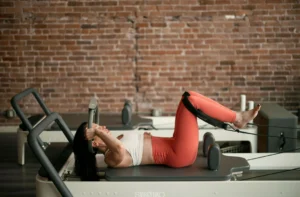
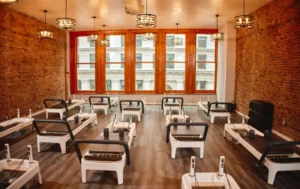
When people picture Pilates these days, this is usually what they see. Imagine a bed frame. Now put a carriage on it that slides, hook on some springs, add a footbar and two straps. That’s a reformer. Springs can fight you or help you, depending how they’re set, so the woman on her first class and the guy who’s been coming for six years can be side by side and both leave tired. More in our reformer Pilates guide, and if you’re deciding between the two, see mat vs reformer Pilates.
Tower Pilates
Tower Pilates uses an upright frame with springs, a push-through bar and straps. Some studios bolt it to the wall; others attach it to the end of a reformer. You’re often lying or sitting on a mat in front of it while the springs add resistance or support from above. It’s a really nice bridge between mat and reformer, and wonderful for stretching and for arm and leg strength.
Wall Pilates
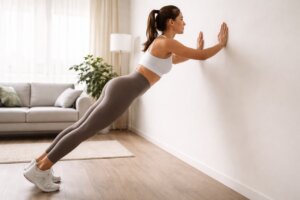
Wall Pilates uses, well, a wall. That’s it. Which is exactly why it blew up as a home workout. The wall gives mat moves a bit of support and something to push against. We get into it in our guide to wall Pilates and wall workouts.
Chair, Cadillac and Barrel Work
You won’t see these much in group classes, but they’re seriously effective. The chair is small and brutal. The Cadillac is a raised table with a frame over it for hanging and spring work. Barrels help with spinal extension and mobility. Mostly you’ll meet them in private sessions. Read more in advanced Pilates equipment explained.
Modern Pilates Formats
What Is Hot Pilates?
So, what is hot Pilates? It’s a Pilates class in a heated room, usually mat-based. You sweat a lot more, and your muscles can feel looser. Classes tend to move faster, with more cardio-ish moves and light weights. Honestly it’s closer to a heated fitness class than traditional Pilates. If you already work out and you like the heat, you might love it. A few cautions though. The heat itself doesn’t burn fat. Pregnant, dealing with heart or blood pressure stuff, or someone who gets woozy in saunas? Skip this one. And drink plenty before and after.
Pilates Fusion
Pilates fusion is Pilates plus a plus-one. Barre, yoga, weights, cardio, take your pick. One day it’s core work with those tiny barre pulses, another day it’s a yoga flow tacked on, or a dumbbell circuit at the end. It’s fun and it changes a lot, but it’s less precise than a straight Pilates class. Curious about the yoga half? See Pilates vs yoga. The barre half? Read barre-inspired workout benefits.
Jumpboard Pilates
A padded board goes on the end of the reformer and you jump. Lying down. It gets your heart rate up without pounding your knees and feet, which is kind of genius. More in jumpboard Pilates for low-impact cardio.
Pilates Equipment Names: A Quick Glossary
Walked into a studio and had no idea what anything was called? Same, once. Here are the main Pilates equipment names, plus the types of Pilates equipment you’ll run into and what they’re for.
| Equipment | What it is | What it is used for |
|---|---|---|
| Mat | A thick exercise mat | Body-weight core work, the base of the method |
| Reformer | Sliding carriage, springs, footbar and straps | Full-body strength, control and mobility |
| Tower | Vertical spring frame with a push-through bar | Stretching, arm and leg strength |
| Cadillac (trapeze table) | Raised table with a frame, bars and springs | Advanced, supported and rehab work |
| Wunda Chair | Small box with a spring-loaded pedal | Balance, leg and core strength |
| Ladder barrel | Curved barrel next to a ladder | Spinal extension, side bends and stretching |
| Spine corrector | Small curved arc | Spine mobility and posture |
| Magic circle | Flexible ring with handles | Inner thigh, arm and chest work |
| Jumpboard | Padded board attached to a reformer | Low-impact cardio |
You don’t need to memorize any of this before your first class. Seriously. Your instructor will show you how to set up and use everything. Just bring grip socks for the reformer.
Types of Pilates Classes You Will See on a Schedule
Schedules also tag classes by level and format, which adds one more layer of confusion. The types of Pilates classes you’ll see over and over: Beginner (some studios say Fundamentals), slower, lots of explaining, basic setups. All levels, where everyone’s in one room and the teacher hands out options. Intermediate and advanced, where transitions get quick and the springs get heavy. Private sessions, one person, one teacher, whatever you need that day. And duets or semi-privates, two or a few people with one teacher, which sits nicely in the middle on price and attention.
Brand new? Start with our list of Pilates exercises for beginners, and skip the usual beginner reformer mistakes while you’re at it.
Which Type of Pilates Is Best for You?
There’s no one best type. It depends what you want out of it. Here’s a cheat sheet:
| Your goal | Try this type of Pilates |
|---|---|
| Get stronger and more toned | Reformer Pilates, intermediate or advanced |
| Start from zero | Beginner reformer class or a private session |
| Recover from an injury | Clinical Pilates or private sessions |
| Improve posture and back health | Reformer or contemporary Pilates |
| Work out at home on a budget | Mat or wall Pilates |
| Sweat and get your heart rate up | Hot Pilates, jumpboard or fusion |
| Learn the method in its purest form | Classical Pilates |
Forced to choose one starting point for most people? Reformer, no contest, and yes, we know we’re a reformer studio. It bends to fit nearly anybody, joints like it, and the core strength you build there makes every other style easier when you go exploring later.
FAQ
What are the different types of Pilates?
What are the different types of Pilates, in short? By approach: classical, contemporary, clinical. By equipment: mat, reformer, tower, chair and the other apparatus. By format: hot Pilates, fusion, jumpboard.
Which type of Pilates is best for beginners?
Beginner reformer, or two or three privates. Springs take some of the load while you figure things out, and the teacher can adjust anything on the fly.
Is mat or reformer Pilates harder?
Mat usually feels harder at first, since nothing’s helping you. Reformer catches up fast once the instructor adds heavier springs and advanced moves.
Is hot Pilates real Pilates?
It uses Pilates-based moves, but the heat, the speed and the added cardio make it closer to a fitness class. Love to sweat? Go for it. Want precise technique? Probably not your class.
Can I mix different types of Pilates?
Yes, and lots of our clients do. Reformer at the studio, mat or wall Pilates at home between classes. Same principles, so they all feed each other.
The Type of Pilates We Teach at BK Pilates
At BK Pilates, a reformer Pilates studio in NYC, our reformer classes are rooted in classical Pilates and adapted with what modern, contemporary teaching has figured out. Groups are small. Beginners, proficient and advanced clients are all welcome, and every exercise comes with options. If you’d like more one-on-one attention, we do privates and duets too.
Find a studio near you in Flatiron, NoMad, Chelsea, Park Slope or South Brooklyn, or at our Pilates studios in Charlotte, Concord and Raleigh. Easiest way to try us out: Camp Pilates, 7 days of unlimited classes for $89. All the options are on our pricing page. Then book your first reformer class.